
Confusing cash flow with profit has tripped up many small business owners across LS25, creating tough moments when bills are due but the bank balance falls short. For those running sole trader businesses in this area, understanding the actual movement of money in and out of your accounts is vital. Clear cash flow management keeps your business operational and helps you plan for growth or setbacks. This guide gives you reliable methods to strengthen control over your finances—so you are never caught off guard.
Table of Contents
- Cash Flow Management—Definition And Misconceptions
- Types Of Cash Flow In Business Accounting
- How Cash Flow Management Works Day-To-Day
- Risks, Pitfalls, And Compliance Issues
- Practical Strategies To Improve Cash Flow
Key Takeaways
| Point | Details |
|---|---|
| Understand Cash Flow vs Profit | Cash flow is the actual money available for business operations, while profit is an accounting figure that may not reflect immediate cash availability. |
| Daily Cash Flow Management | Regularly check bank balances and transactions to anticipate shortfalls and avoid surprises. |
| Address Common Misconceptions | Recognise that high sales do not guarantee cash availability and that cash flow requires active management, not passive oversight. |
| Implement Practical Strategies | Accelerate cash inflows and delay non-essential payments to improve cash management, while also maintaining a cash reserve for stability. |
Cash flow management—definition and misconceptions
Cash flow management sounds straightforward until you realise many business owners confuse it with profit. They're not the same thing, and this distinction matters for your financial survival.
Cash flow is the actual money moving in and out of your business bank account. It's what you can spend, pay your staff with, and use to keep the lights on. Profit, by contrast, is what remains after deducting expenses from revenue—but it can sit on a balance sheet without ever touching your account.
Here's the practical difference: You might be profitable on paper yet run out of cash to pay suppliers next month. This contradiction catches countless small business owners off guard.
To clarify the practical differences between cash flow and profit, see this straightforward comparison:
| Aspect | Cash Flow | Profit |
|---|---|---|
| Timing | Tracks real money movement | Includes unpaid future amounts |
| Reliability for decisions | Immediate and actionable | Can be misleading if not up-to-date |
| Influenced by accounting | Not easily manipulated | Subject to accounting choices |
| Key risk | Running out of money despite profit | False confidence from paper profit |
Why This Distinction Matters
Profit figures can be manipulated through accounting methods, but cash flow represents actual cash generated. Your bank balance doesn't lie. When you invoice a client for £5,000, that's revenue. When they actually pay you three months later, that's when cash flow occurs.
For sole traders in LS25, this timing gap creates real pressure. You might owe your tax bill, staff wages, or supplier invoices before customer payments arrive.
Common Misconceptions
Most business owners hold at least one false belief about cash flow:
- "Profit equals cash" – Your accounts show £20,000 profit but your bank shows £2,000. Where did it go? Stock purchases, equipment, and unpaid customer invoices.
- "Strong sales mean strong cash" – High turnover on credit terms depletes your cash position quickly.
- "I don't need to track it monthly" – Cash flow changes weekly or daily, especially for seasonal trades.
- "My accountant handles it" – Accountants report what happened. You need to forecast what's coming.
- "Cash flow is just about survival" – It's also about growth capacity and investment decisions.
Cash flow is not a nice-to-have metric for small businesses—it's the pulse of your operation and the single most reliable indicator of financial health.
Understanding this foundation transforms how you make decisions. You'll stop chasing vanity profit figures and start protecting the cash that actually runs your business.
Pro tip: Set up a simple daily bank balance check each morning for two weeks. Track the actual cash moving in and out, then compare it to your profit figures from the same period. You'll see the gap immediately.
Types of cash flow in business accounting
Business cash flow breaks down into three distinct categories. Understanding each one reveals where your money comes from and where it goes. This clarity transforms how you manage your finances.
The cash flow statement divides activities into three categories: operating, investing, and financing. Each tells a different story about your business health.
Operating Cash Flow
Operating cash flow is money generated from your core business activities. It's the cash from selling your products or services, minus what you spend running day-to-day operations.
For a sole trader in LS25, this is your lifeline. It covers staff wages, supplier invoices, utilities, and rent. If operating cash flow turns negative, you're spending more than you're earning from actual business activity.
Think of it this way: You invoice clients £10,000 monthly but only collect £6,000 because they pay slowly. Your operating cash flow is £6,000, not £10,000.
Investing Cash Flow
Investing cash flow tracks money spent buying or selling assets. This includes equipment, vehicles, property, or investments in your business infrastructure.
When you purchase a new van or office equipment, that's negative investing cash flow. When you sell old assets, that's positive investing cash flow.
Small business owners often overlook this category. You might have brilliant operating cash flow but drain it all on new equipment, leaving nothing for taxes or emergencies.
Financing Cash Flow
Financing cash flow covers loans, investments, and owner withdrawals. Money borrowed from the bank or paid back to lenders appears here, along with personal drawings from the business.
If you take a £25,000 bank loan, that's positive financing cash flow. When you repay it, that's negative financing cash flow.
Compare the three types:
Here is an at-a-glance summary of the three main types of cash flow in business accounting:
| Cash Flow Type | Typical Transactions | Effect on Daily Operations |
|---|---|---|
| Operating | Customer receipts, supplier payments | Keeps the business running daily |
| Investing | Equipment purchase, asset sales | Affects long-term capacity or costs |
| Financing | Bank loans, equity injections, owner draw | Changes overall funding structure |
- Operating – Daily business money in and out
- Investing – Asset purchases and sales
- Financing – Loans, investments, and owner withdrawals
All three categories matter equally. Strong operating cash flow means nothing if you over-invest in equipment you don't need or over-borrow from lenders.
Most businesses focus only on operating cash flow. Neglecting the other two creates blind spots that sink otherwise profitable companies.
Pro tip: Request or create a cash flow statement showing all three categories for the past three months. Highlight which category is draining your cash fastest, then address that weakness.
How cash flow management works day-to-day
Daily cash flow management isn't complicated, but it does require consistency. You're essentially tracking money coming in, money going out, and adjusting based on what you see.

Daily cash flow management involves forecasting needs, scheduling payments, and monitoring balances. These aren't one-time tasks—they happen repeatedly, building a rhythm that keeps your business stable.
The Daily Cycle
Start each morning by checking your bank balance. This takes five minutes but reveals your actual financial position right now.
Then review what's due today. Do you have supplier payments scheduled? Are customer invoices due? This simple awareness prevents overdraft fees and late payment penalties.
Record every transaction as it happens, not weekly or monthly. A £50 purchase made on Monday becomes a data point for your forecast. When you batch entries together, patterns disappear.
Managing Inflows and Outflows
Inflows are customer payments, loan advances, or owner investments. Outflows are wages, rent, stock purchases, and tax payments.
Tracking money in and out plus predicting future positions enables you to adjust business activities accordingly. You spot shortfalls before they happen.
The key is timing. You might know £8,000 arrives on the 20th but £5,000 goes out on the 15th. That gap matters. Without it, you might panic unnecessarily or overdraft when you didn't need to.
Three Daily Habits
Building strong cash flow management requires three repeatable actions:
- Monitor – Check bank balance and upcoming due dates each morning
- Record – Log every transaction on the day it occurs
- Forecast – Update your cash position for the next 30 days weekly
These aren't burdensome. They're the difference between reactive firefighting and proactive management.
Cash flow problems never arrive as surprises if you're checking daily. They announce themselves weeks in advance, giving you time to respond.
Small business owners who do this consistently avoid most cash flow crises. Those who skip it scramble when unexpected bills arrive.
Pro tip: Set a phone reminder for 9am each weekday to check your bank balance and log transactions. Three weeks of consistency builds a habit that saves thousands in avoided overdraft fees.
Risks, pitfalls, and compliance issues
Cash flow problems don't announce themselves politely. They creep in quietly until your bank account is nearly empty and bills are due tomorrow. Understanding the common risks and pitfalls helps you avoid becoming another cautionary tale.
The biggest risks in cash flow management stem from liquidity shortfalls, inadequate forecasting, and poor controls that compromise firm performance. For sole traders in LS25, these aren't abstract financial concepts—they're threats to your ability to pay yourself and keep the business running.
Common Pitfalls
Most business owners repeat the same mistakes. You track cash reactively instead of forecasting ahead. You rely on inaccurate or outdated cash position data, making decisions based on yesterday's information.
Timing mismatches cause havoc. You collect payment from one client in 60 days but must pay suppliers in 30 days. That gap compounds monthly until you're perpetually short of cash.
High leverage amplifies vulnerability. Borrowing heavily to fund growth works brilliantly until it doesn't. One slow month triggers a cascade of missed payments and overdraft fees.
Compliance and Reporting Risk
Accuracy in cash flow reporting matters legally and financially. Improper tracking and lack of unified approaches increase operational and financial risks. Omitting or misclassifying cash flows violates accounting standards and creates audit headaches.
Your cash flow statement must match your bank records. If it doesn't, you've got a problem that HMRC or an accountant will spot quickly.
Specific Risks for Small Traders
Your vulnerabilities differ from large companies:
- No safety net – One lost client can devastate your cash position
- Seasonal swings – Summer quiet periods drain reserves you built in winter
- Owner dependency – Your personal finances merge with business finances
- Limited borrowing capacity – Banks hesitate to lend to sole traders with volatile income
- No delegation – You handle everything yourself, so gaps appear easily
Compliance isn't just about keeping HMRC happy. It's about having accurate data so you can make real decisions instead of guessing.
These risks are preventable. Proper forecasting, regular monitoring, and accurate record-keeping eliminate most cash flow crises before they start.
Pro tip: Review your last three months of bank statements and identify any transactions you didn't record immediately. That gap reveals your weak spots in tracking and forecasting.
Practical strategies to improve cash flow
Improving cash flow isn't about magic or luck. It's about making deliberate choices that shift the timing of money in your favour. Small changes compound into significant improvements.
Optimising cash collections, delaying non-essential payments, and maintaining liquidity buffers form the foundation of effective cash flow management. These aren't complex strategies—they're practical habits you can implement immediately.
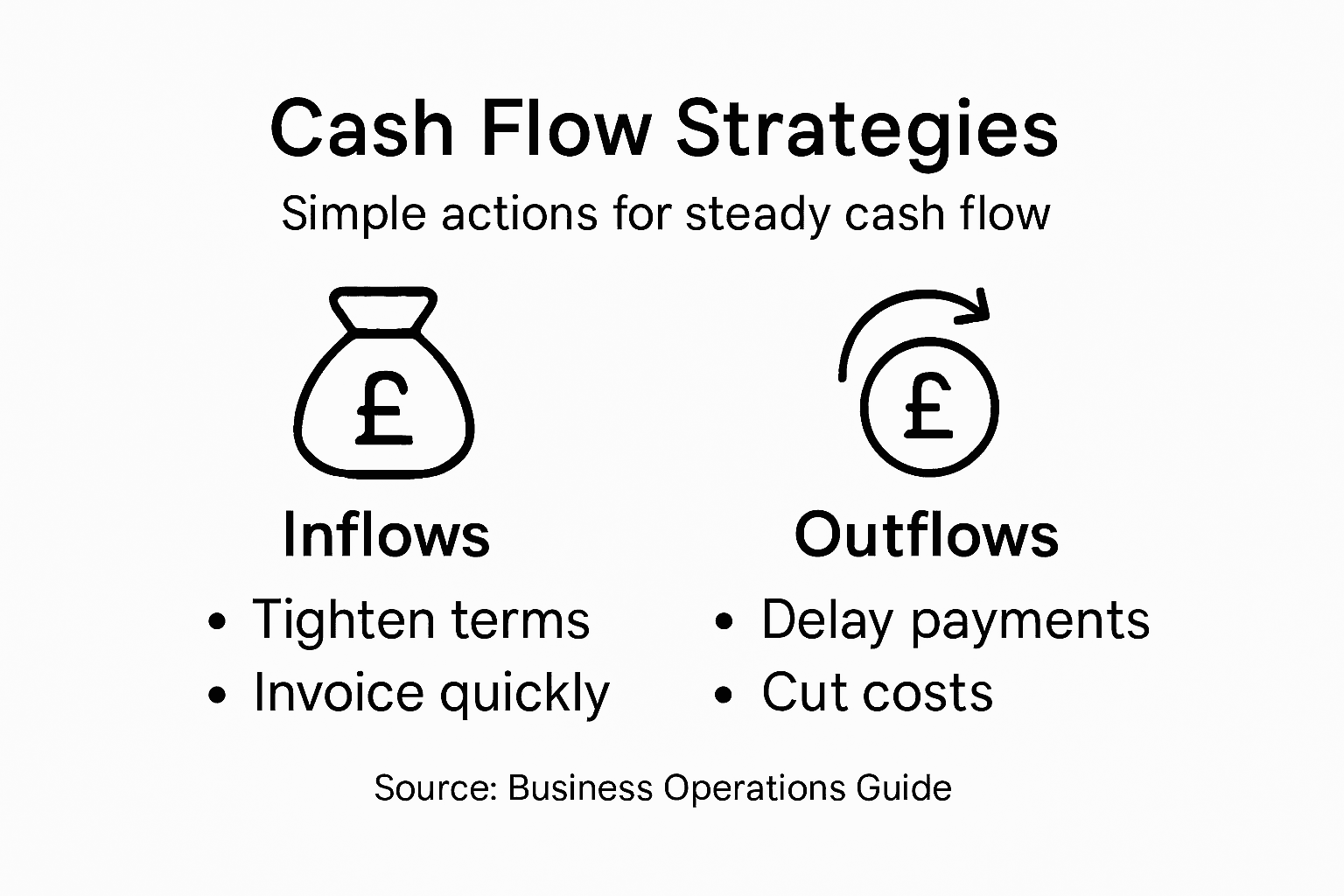
Accelerate Your Cash Inflows
Faster payments mean better cash flow. Start by tightening your payment terms. If you currently allow 60 days, move to 45 days or 30 days for new clients.
Offer a small discount for early payment. Many clients pay immediately if you knock 2% off for payment within 7 days. The discount costs less than the interest you'd pay borrowing money to cover the gap.
Make invoicing automatic. Send invoices the day work completes, not weeks later. Invoice late, get paid late—it's that straightforward.
Slow Down Your Cash Outflows
This doesn't mean dodging payments or damaging supplier relationships. It means paying strategically, not reactively.
Negotiate longer payment terms with suppliers. If you've been paying on 30 days, ask for 45 or 60 days. Many suppliers agree if you've been reliable.
Batch your payments. Instead of paying bills as they arrive, schedule payments for specific dates—perhaps the 15th and 30th of each month. This rhythm prevents the bleeding effect of constant small payments.
Build a Cash Reserve
A buffer protects you during slow months and unexpected expenses. Aim for enough cash to cover 30 days of operating costs. For many LS25 traders, this means £3,000 to £8,000 depending on overhead.
You don't build this overnight. Each month, set aside a portion of profit as reserve. Treat it as non-negotiable, like paying tax.
Key Strategies
These moves transform your cash position:
- Monitor weekly – Track cash daily, review trends weekly
- Forecast monthly – Project 12 weeks ahead using historical patterns
- Chase outstanding invoices – Call clients at day 45 if payment isn't due until day 60
- Reduce stock holding – Unsold inventory ties up cash
- Separate personal and business – Don't mix owner drawings with operational needs
The difference between struggling traders and stable ones isn't revenue—it's how they manage the timing of money in and out.
Once these strategies run automatically, you'll notice the pressure lifting. You'll have breathing room to make decisions instead of reacting constantly.
Pro tip: Calculate your average daily operating costs by dividing last month's expenses by 30. That number tells you exactly how many days of cash buffer you need to feel safe.
Take Control of Your Cash Flow Today
Managing cash flow effectively is one of the greatest challenges facing small businesses and sole traders in LS25. The article highlights critical pain points such as timing mismatches between inflows and outflows, inaccurate forecasting, and the daily need to monitor bank balances to avoid liquidity shortfalls. Understanding operating, investing, and financing cash flow is essential to protect your business from unexpected crises and build a strong financial foundation.
Don't leave your cash flow to chance or outdated accounting alone. Our expert team at LS25 Accountants specialises in helping businesses transform their cash flow management through practical, tailored solutions. Benefit from faster invoicing, clearer forecasting, and strategic payment scheduling that together create the breathing room your business deserves. Visit our homepage now and discover how expert guidance can safeguard your stability and power your growth with confidence.
Frequently Asked Questions
What is the difference between cash flow and profit?
Cash flow refers to the actual money moving in and out of your business, while profit is the amount left after deducting expenses from revenue. You can be profitable on paper but still face cash flow issues if the money hasn’t yet been received.
How can I improve my cash inflows?
To improve cash inflows, tighten your payment terms, offer discounts for early payments, and automate your invoicing process. Sending invoices promptly after work completion helps ensure quicker payments.
What are some common pitfalls in cash flow management?
Common pitfalls include reactive tracking of cash flow, relying on outdated information, and failing to forecast future cash needs. Timing mismatches between receivables and payables can also create significant cash flow challenges.
How can I build a cash reserve for my business?
To build a cash reserve, aim to set aside a portion of your profits each month. Keep enough cash to cover at least 30 days of operating costs, treating this reserve as a non-negotiable expense, similar to tax payments.