
Managing business expenses effectively can mean the difference between a healthy cash flow and a financial headache for UK small businesses. Whether you're a sole trader or running a limited company in the LS25 area, understanding which costs you can legitimately claim, how to track them efficiently, and the best methods to reduce your tax bill is essential. This guide walks you through allowable expenses under HMRC rules, simplified versus actual expense methods, practical tracking strategies, common pitfalls to avoid, and how professional support can transform your financial management. By the end, you'll have actionable insights to optimise your expense management and keep more money in your business.
Table of Contents
- Key takeaways
- Understanding allowable business expenses
- Choosing simplified versus actual expense methods
- Practical strategies for tracking and managing expenses
- Common mistakes to avoid and verifying expense claims
- Manage your business expenses with expert LS25 accountants
- Frequently asked questions about managing business expenses
Key Takeaways
| Point | Details |
|---|---|
| Allowable expenses rules | Only costs wholly for business are deductible and mixed use must be apportioned with evidence. |
| Simplified versus actual | You can choose either simplified flat rates or actual costs for certain expenses and may switch annually to suit your circumstances. |
| Home working rates | For home working you can claim flat rates of £10, £18 or £26 depending on hours worked, with no receipts needed. |
| Tax liability reserve | Set aside 20 to 30 per cent of income to cover tax liabilities. |
Understanding allowable business expenses
HMRC allows you to deduct expenses that are wholly and exclusively for business purposes, reducing your taxable profits for Income Tax and Class 4 National Insurance. This means every pound you legitimately claim saves you tax. The key test is whether the expense was incurred entirely for your trade. If there's any personal benefit, you must apportion the cost fairly or risk an HMRC enquiry.
Common allowable categories include office costs like stationery and phone bills, travel expenses such as fuel and public transport, professional fees for accountants or solicitors, staff costs including wages and pensions, and marketing expenses like website hosting or advertising. You can also claim business insurance, bank charges, and software subscriptions. Each category has specific rules, so understanding the boundaries prevents costly mistakes.
Mixed use expenses require careful handling. If you use your car for both business and personal trips, you can only claim the business proportion. Similarly, if you work from home, you must calculate the business use percentage of your mortgage interest, council tax, and utilities. HMRC expects reasonable and consistent apportionment methods backed by evidence.
Some costs are never allowable. Personal expenses like clothing, unless it's a uniform or protective gear, cannot be claimed. Client entertainment is generally disallowed, though staff entertainment has different rules. Fines, penalties, and personal tax bills are also excluded. Understanding these boundaries protects you from compliance issues.
Capital expenses like buying equipment or vehicles are handled differently through capital allowances. The Annual Investment Allowance lets you deduct up to £1 million on qualifying assets in the year of purchase, providing significant tax relief for growth investments. For detailed guidance on maximising deductions, explore our tax deduction guide 2026.
Pro Tip: Create a simple checklist of your regular business expenses and review it monthly. This ensures you don't miss legitimate claims and keeps your records current for year end.
Choosing simplified versus actual expense methods
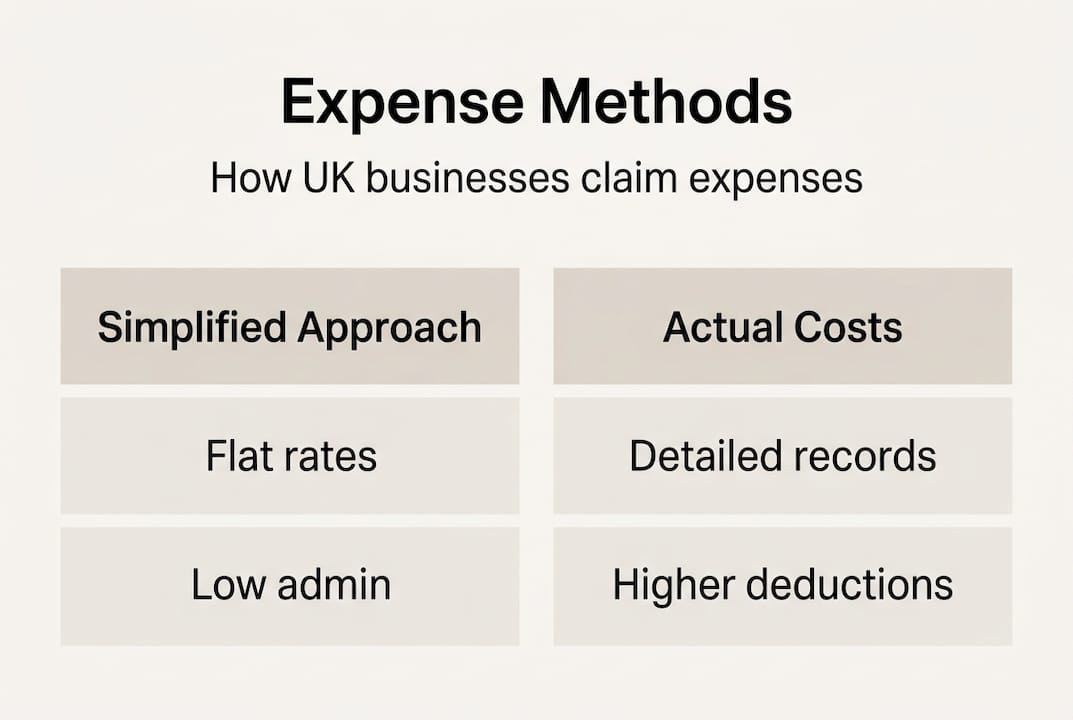
HMRC offers two ways to claim certain expenses: simplified flat rates or actual costs. Choosing the right method can save you significant time or money, depending on your circumstances. The decision isn't permanent, you can switch annually, but understanding the trade offs helps you optimise your claims.
Simplified expenses reduce administrative burden by using HMRC flat rates for working from home. For home working, you claim £10 per month if you work 25 to 50 hours monthly, £18 for 51 to 100 hours, and £26 for over 100 hours. No receipts or calculations needed, just track your hours. This method works well if your actual costs are low or record keeping feels overwhelming.
Actual costs require detailed records but often yield higher deductions. For home working, you calculate the business proportion of mortgage interest, rent, council tax, utilities, internet, and building insurance. If your office occupies 15 percent of your home and you use it 40 hours weekly, you might claim 15 percent of eligible costs. This method suits those with high housing costs or dedicated office spaces.
For vehicle expenses, HMRC mileage rates for 2026 are 45 pence per mile for the first 10,000 miles in cars or vans, then 25 pence thereafter. Motorcycles get 24 pence per mile, bicycles 20 pence. This simplified method covers all running costs including fuel, insurance, servicing, and depreciation. Alternatively, actual costs let you claim fuel, insurance, repairs, and vehicle tax proportionate to business mileage, plus capital allowances on the purchase price.
| Expense type | Simplified method | Actual costs method | Best for |
|---|---|---|---|
| Home working | £10 to £26 monthly flat rate | Apportion mortgage, utilities, council tax | Flat rate: low costs or simple records; Actual: high housing costs |
| Vehicle mileage | 45p/25p per mile | Fuel, insurance, repairs, capital allowances | Flat rate: high mileage, lower costs; Actual: expensive vehicle, low mileage |
Compare both methods annually before filing your tax return. If you drive 15,000 miles, simplified expenses give you £6,250. If your actual costs are £8,000 and 80 percent is business use, you could claim £6,400, a better result. Once you choose actual costs for a vehicle, you cannot switch back to simplified for that vehicle, so consider long term implications.
Pro Tip: Run both calculations each tax year before deciding. Your circumstances change, and what worked last year might not be optimal now. Keep a simple mileage log and basic cost records so you have the data ready.
Practical strategies for tracking and managing expenses
Effective expense management starts with organisation. Separate bank accounts for business and personal use eliminate confusion and make reconciliation straightforward. When every transaction in your business account is legitimate, tracking becomes simple. Mixing accounts creates hours of extra work sorting personal from business spending.

Categorise expenses consistently from day one. Create categories matching your tax return requirements: office costs, travel, marketing, professional fees, and so on. Consistent categorisation makes year end reporting faster and helps you spot spending patterns. Reconcile your accounts monthly rather than waiting until year end. Monthly checks catch errors early and keep you aware of your financial position.
Accounting software with bank feed integrations transforms expense management. Tools like Xero, ANNA, QuickBooks, and FreeAgent automatically import transactions, categorise them using rules you set, and generate reports instantly. Many offer free tiers suitable for sole traders, making professional grade tools accessible. Software also ensures Making Tax Digital compliance, a legal requirement for VAT registered businesses and soon for Income Tax.
Follow these steps for robust expense tracking:
- Open a dedicated business bank account and use it exclusively for trade
- Choose accounting software that integrates with your bank and suits your business size
- Set up expense categories matching HMRC requirements and your reporting needs
- Capture receipts digitally using your phone camera or scanner immediately after purchase
- Reconcile transactions weekly or monthly to catch errors and maintain accuracy
- Review spending patterns quarterly to identify cost savings and budget adjustments
Budgeting for tax obligations prevents nasty surprises. Set aside 20 to 30 percent of your income to cover Income Tax and National Insurance. Adjust this percentage based on your profit level and expense claims. High earners may need 40 percent or more, whilst those with significant expenses might manage with less. Regular savings into a separate tax account ensure funds are available when payments are due.
Maintaining digital records supports Making Tax Digital compliance and simplifies HMRC enquiries. Store receipts, invoices, and bank statements digitally for at least six years. Cloud storage with automatic backup protects against loss. Good records also help you make better business decisions by showing exactly where money goes. For comprehensive guidance on staying compliant, review our tax compliance guide.
Common pitfalls include mixing personal expenses into business accounts, failing to keep receipts, and neglecting regular reconciliation. These mistakes lead to inaccurate records, missed deductions, and potential HMRC penalties. Establishing good habits from the start saves significant time and stress. Our small business accounting tips provide additional strategies for maintaining financial control.
Pro Tip: Schedule a monthly money date with your business finances. Spend an hour reviewing transactions, reconciling accounts, and checking your tax savings balance. Regular attention prevents problems from accumulating.
Common mistakes to avoid and verifying expense claims
Even experienced business owners make expense mistakes that trigger HMRC enquiries or result in overpaid tax. Understanding common errors helps you avoid them and keeps your claims defensible.
Never claim personal expenses as business costs. Groceries, personal clothing, gym memberships, and family outings are not allowable, even if you discuss work occasionally. HMRC scrutinises lifestyle expenses closely. Thirty percent of HMRC enquiries stem from mixed use errors, where business owners claim 100 percent of costs that have personal elements.
Apportionment is essential for mixed use items. If you use your mobile phone 60 percent for business, claim only 60 percent of the bill. Keep call logs or usage records to support your calculation. Claiming 100 percent without justification invites challenge. The same applies to vehicles, home working costs, and any shared resources.
Poor documentation undermines legitimate claims. Without receipts, bank statements, or invoices, HMRC may disallow expenses entirely. Digital tools make capturing evidence easy, so there's no excuse for missing records. Photograph receipts immediately, especially thermal paper ones that fade over time. Store them in your accounting software or cloud storage with transaction details.
Client entertainment costs are generally not allowable, a rule that catches many business owners by surprise. Taking a client to lunch or a sporting event is disallowed, even if it directly generates business. Staff entertainment, however, has different rules and may be allowable under certain conditions. Understanding these distinctions prevents incorrect claims.
Review your expense claims regularly, ideally quarterly. Check that categories are correct, personal items haven't crept in, and apportionments remain reasonable. Annual reviews before filing your tax return catch errors whilst there's time to correct them. If you're unsure about a claim, seek professional advice rather than guessing. Our tax advisor benefits 2026 article explains how expert support saves more than it costs.
Prepare for possible HMRC enquiries by maintaining comprehensive records and being able to explain your claims. Enquiries aren't accusations, they're compliance checks. If your records are solid and claims legitimate, enquiries resolve quickly. Keep a summary document explaining your apportionment methods and significant expense categories. This demonstrates professionalism and makes responding to queries straightforward.
Key mistakes to avoid:
- Claiming personal expenses like clothing, groceries, or entertainment without business justification
- Failing to apportion mixed use costs correctly between business and personal use
- Missing receipts or documentation to support expense claims
- Claiming 100 percent of client entertainment costs
- Neglecting to review and verify claims before submission
As one accountant wisely noted:
The difference between tax avoidance and tax evasion is documentation. Legitimate expenses with proper records are legal tax planning. The same expenses without evidence become a compliance risk.
Building verification into your routine protects your business and ensures you claim everything you're entitled to without crossing lines.
Manage your business expenses with expert LS25 accountants
Navigating expense management, HMRC rules, and tax efficiency can feel overwhelming when you're focused on running your business. That's where professional support makes a tangible difference. Working with experienced accountants who understand the specific challenges facing small businesses in the LS25 area ensures you're claiming every legitimate expense whilst staying fully compliant.
Our team at LS25 Accountants provides tailored advice on expense categorisation, choosing between simplified and actual cost methods, and implementing accounting systems that save you time. We help you set up efficient record keeping processes, select the right software for your needs, and prepare for Making Tax Digital requirements. Our clients typically save 15 percent or more on their tax bills through optimised expense management and strategic planning.
Whether you need help understanding allowable expenses, want to review your current claims, or need ongoing support managing your finances, we're here to help. Explore our tax planning checklist 2026 for additional strategies, or discover why hiring a tax advisor delivers measurable returns. Let's work together to strengthen your financial foundation and free up your time for what you do best.
Frequently asked questions about managing business expenses
Can I claim personal phone bills as business expenses?
You can claim only the business proportion of your phone bills, not the entire cost. Keep detailed call logs or usage records showing what percentage relates to business calls and data use. If 60 percent of your usage is business related, claim 60 percent of the monthly bill. Claiming 100 percent without evidence of exclusive business use will likely be challenged by HMRC.
What is the benefit of using accounting software for expense management?
Accounting software automates record keeping by importing bank transactions, categorising expenses using rules you define, and generating reports instantly. This saves hours monthly compared to manual spreadsheets. Software also ensures Making Tax Digital compliance, which is legally required for VAT registered businesses and will soon extend to Income Tax. Many platforms offer free tiers for sole traders, making professional tools accessible to all business sizes.
How much of my income should I set aside for tax related to expenses?
Set aside 20 to 30 percent of your income to cover Income Tax and National Insurance contributions. This percentage should be adjusted annually based on your profit level and the expenses you claim. Higher earners in the 40 percent tax bracket may need to save 40 percent or more, whilst those with significant allowable expenses might manage with less. Regular savings into a dedicated tax account prevent cash flow problems when payment deadlines arrive.
How long must I keep expense records and receipts?
HMRC requires you to keep business records for at least six years from the end of the relevant tax year. This includes receipts, invoices, bank statements, and any documentation supporting your expense claims. Digital records are acceptable and often more practical than paper storage. Failing to maintain adequate records can result in disallowed expenses and potential penalties during HMRC enquiries.