You receive your payslip and notice a cryptic code like 1257L or BR beside your income tax deduction. What does it mean? Tax codes often cause confusion and payroll errors for UK business owners and self-employed individuals, yet understanding them is essential for tax compliance and financial planning. This guide explains UK tax codes, their types, and their practical implications. You'll learn how HMRC uses these codes to calculate your tax deductions, what common codes signify, and how to spot errors that could cost you money. We'll also cover Self Assessment deadlines and the upcoming Making Tax Digital changes affecting businesses from April 2026.
Table of Contents
- Key takeaways
- What is a UK tax code and how does it work?
- Common UK tax codes and their meanings
- Special cases and tax code corrections
- Self Assessment compliance and upcoming changes for business owners
- How LS25 Accountants can help you with tax codes and compliance
- Frequently asked questions
Key Takeaways
| Point | Details |
|---|---|
| Tax codes explained | A UK tax code tells employers how much income tax to deduct from your pay based on your personal allowance. |
| Common codes explained | Common codes include 1257L BR D0 0T NT and their meanings guide how tax is applied and where allowances are used. |
| Check your code regularly | Regularly verify your tax code to avoid overpaying or underpaying tax and catch errors early. |
| Self Assessment and MTD | The article highlights Self Assessment deadlines and the forthcoming Making Tax Digital updates from April 2026 for businesses. |
What is a UK tax code and how does it work?
A UK tax code is a number-letter combination issued by HMRC to employers and pension providers under the PAYE system, instructing how much Income Tax to deduct from an employee's pay or pension by specifying the tax-free personal allowance and any adjustments. Your employer receives this code and uses it to calculate the correct tax deduction from your wages each pay period. The code ensures you pay the right amount of tax throughout the year without needing to file a tax return.
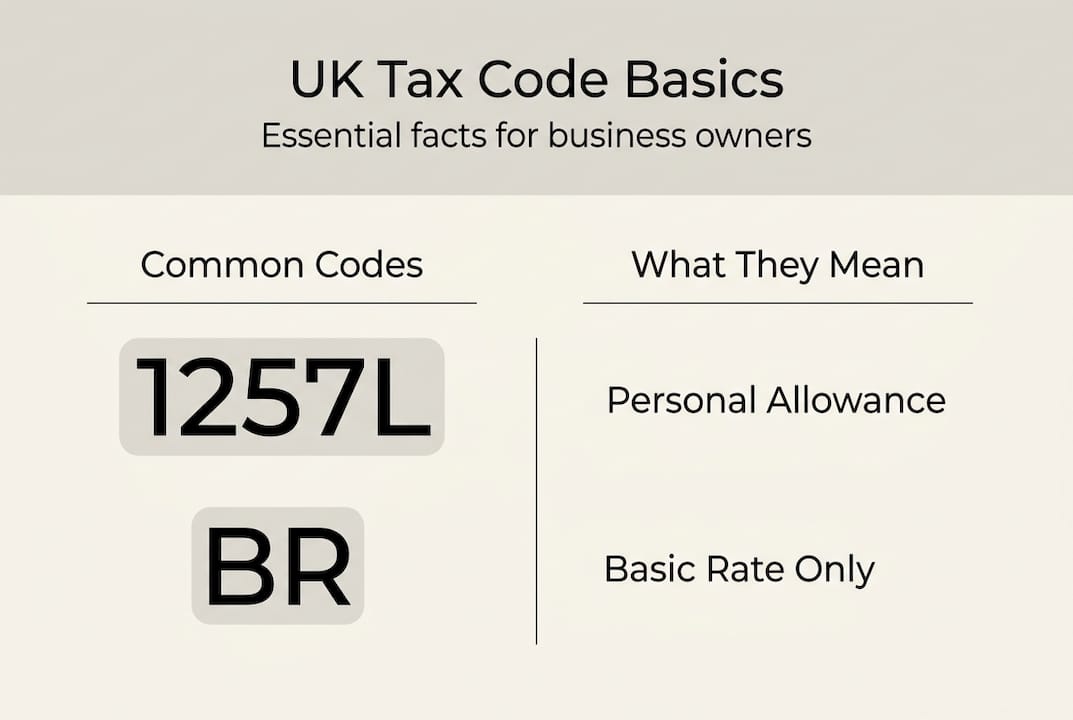
The standard code for 2026 is 1257L, which reflects the personal allowance of £12,570. The number in your code relates directly to your allowance: multiply the number by 10 to get your tax-free amount. So 1257 multiplied by 10 equals £12,570. The letter L indicates you're entitled to the standard personal allowance with no adjustments. If HMRC applies adjustments for company benefits, second jobs, or unpaid tax from previous years, your code will differ.
Several factors can alter your tax code:
- Company car or private medical insurance provided by your employer
- Multiple jobs or pensions running simultaneously
- Underpaid tax from previous years being collected
- State pension income affecting your allowance
- High earnings over £100,000 reducing your personal allowance
Your code appears on every payslip, so you can monitor whether HMRC has applied the correct allowance. Checking your code matters because research suggests one in three codes may be wrong, leading to overpayment or underpayment of tax. You can verify your code through your Personal Tax Account on the HMRC website or by calling their helpline.
Pro Tip: Log into your HMRC Personal Tax Account every quarter to check your tax code matches your circumstances. If you've changed jobs, received a pay rise, or your benefits changed, your code should reflect these updates. Catching errors early prevents large bills or refunds at year end.
Common UK tax codes and their meanings
Understanding the most frequently used tax codes helps you interpret your payslip and spot potential errors. Each code combines numbers showing your allowance with letters indicating special circumstances. The letter suffix tells your employer how to apply tax rates and allowances to your income.
Common tax codes include 1257L for the standard personal allowance, BR for basic rate with no allowance on second jobs, D0 for higher rate at 40%, 0T when you have no allowance, NT when no tax applies, and T when complex adjustments require manual review. Scotland and Wales use prefix letters S and C respectively to apply their devolved tax rates. Emergency codes like 1257L W1, M1, or X apply temporarily when HMRC lacks complete information about your circumstances.

| Tax code | Meaning | When it applies |
|---|---|---|
| 1257L | Standard personal allowance | Most employees with one job |
| BR | Basic rate 20%, no allowance | Second jobs or pensions |
| D0 | Higher rate 40%, no allowance | Additional income already using allowance |
| 0T | No allowance, tax at all bands | Personal allowance used elsewhere or complex case |
| NT | No tax deducted | Specific exemptions or non-residents |
| S1257L | Scottish resident standard code | Living in Scotland |
| C1257L | Welsh resident standard code | Living in Wales |
The BR code commonly appears on second jobs because HMRC assumes your main employment uses your full personal allowance. If you earn £30,000 from your primary job and £10,000 from a second job, the second employer will use BR to tax that £10,000 at 20% with no allowance. This prevents you from claiming the allowance twice. Similarly, D0 applies when you're a higher rate taxpayer and additional income should be taxed at 40% immediately.
Emergency codes signal temporary arrangements:
- W1 or M1 suffix means tax calculated on current period only, not cumulative
- X suffix indicates similar non-cumulative treatment
- Applied when starting a new job without providing a P45
- Remain until HMRC receives correct information from previous employer
These codes can result in overpaying tax initially because they don't account for your full year allowance. Once HMRC updates your records, they'll issue a correct code and you'll receive a refund if you've overpaid. The T code appears when your tax situation requires individual calculation, such as high earners losing personal allowance or those with multiple adjustments that don't fit standard codes.
Special cases and tax code corrections
Edge cases arise when standard codes don't cover your circumstances. Emergency codes like 1257L W1, M1, or X apply when you start a new job without providing a P45 from your previous employer. These codes calculate tax on each pay period in isolation rather than cumulatively across the tax year. This means you might pay more tax initially because the code doesn't spread your annual allowance across all pay periods.
Dynamic coding allows HMRC to adjust your code mid-year when they discover underpayments from previous years or current year discrepancies. If you underpaid £500 last year and HMRC decides the amount is small enough to collect through PAYE rather than a lump sum demand, they'll reduce your allowance by £50 and issue a code like 1207L. The reduced allowance means you'll pay an extra £10 tax per month to clear the debt over the year.
HMRC can also code out small Self Assessment debts through your PAYE code if you're employed and the debt is under £3,000. This spreads repayment across the tax year through reduced allowances rather than requiring a single payment. For example, a £1,200 Self Assessment debt might reduce your code to 1137L, collecting £100 extra tax per month. This only works if you have sufficient income to cover the adjustment without dropping below minimum wage.
The T code appears in complex situations:
- High earners with income over £100,000 losing personal allowance gradually
- Multiple benefits, pensions, or income sources requiring individual calculation
- Specific reliefs or deductions that don't fit standard code formats
- Cases where HMRC needs to review your circumstances manually
Incorrect codes cause significant problems. Overcollecting tax reduces your monthly income and requires claiming a refund at year end. Undercollecting creates a tax bill you must pay later, potentially with interest if the underpayment is substantial. Auditing your payroll regularly helps catch these errors before they accumulate.
Pro Tip: When you receive a new tax code notice from HMRC, check it immediately against your circumstances. If anything looks wrong, contact HMRC within 30 days to query it. Don't wait until the end of the tax year when correcting errors becomes more complicated and you might face cashflow problems from large bills or delayed refunds.
Self Assessment compliance and upcoming changes for business owners
Self Assessment compliance requires meeting strict deadlines to avoid penalties. The online filing deadline is 31 January following the end of the tax year, with payment of any tax owed due the same day. Missing these deadlines triggers an escalating penalty structure that can significantly impact your business cashflow. A second payment on account is due by 31 July for the following tax year.
Penalty structure for late filing:
| Timing | Penalty amount |
|---|---|
| 1 day late | £100 fixed penalty |
| 3 months late | £10 per day for up to 90 days (maximum £900) |
| 6 months late | 5% of tax due or £300, whichever is greater |
| 12 months late | Additional 5% of tax due or £300, whichever is greater |
Late payment attracts separate penalties: 5% of unpaid tax at 30 days, another 5% at 6 months, and a final 5% at 12 months, plus daily interest on the outstanding amount. These penalties apply even if you filed on time but paid late. For a £10,000 tax bill paid 13 months late, you'd face £1,500 in percentage penalties alone, plus interest charges.
Making Tax Digital for Income Tax Self Assessment begins in April 2026 for sole traders and landlords with annual business or property income over £50,000. This requires:
- Keeping digital records using compatible software
- Submitting quarterly updates to HMRC showing income and expenses
- Filing an End of Period Statement after each tax year
- Submitting a final declaration by 31 January
The threshold drops to £30,000 in April 2027 and £20,000 in April 2028, eventually covering most self-employed individuals. Digital record keeping means you cannot use paper records or basic spreadsheets that don't link to HMRC-approved software. The quarterly updates don't create tax payments but provide HMRC with real-time visibility of your business performance.
Immediate actions if you miss a deadline:
- File or pay immediately to stop daily penalties accumulating
- Contact HMRC to explain reasonable excuses like serious illness or bereavement
- Set up a Time to Pay arrangement if you cannot pay the full amount
- Consider whether appealing penalties is worthwhile based on your circumstances
- Implement systems to prevent future missed deadlines
Understanding tax deductions and compliance requirements helps you plan cashflow and avoid penalties. Many business owners underestimate the administrative burden of quarterly digital reporting under Making Tax Digital. Starting preparation now, even if you're not in the first wave, prevents rushed implementation and potential errors when your threshold applies.
How LS25 Accountants can help you with tax codes and compliance
Navigating tax codes, PAYE adjustments, and Self Assessment compliance can feel overwhelming when you're focused on running your business. Professional support ensures you're paying the right amount of tax and meeting all filing obligations without penalties.
LS25 Accountants provides tailored tax advisory and payroll services for UK business owners and self-employed individuals across the LS25 postcode area. Our team reviews your tax codes to identify errors, helps you understand complex adjustments, and manages your Self Assessment filing to meet deadlines. We also prepare businesses for Making Tax Digital quarterly reporting, implementing compatible software and processes before the mandatory start date. Whether you need help interpreting an unusual tax code or setting up compliant digital record keeping, our expert guides and personalised support ensure you stay compliant while maximising your tax efficiency. Contact us today to discuss how we can simplify your tax obligations.
Frequently asked questions
What happens if my tax code is wrong?
An incorrect tax code causes you to overpay or underpay tax throughout the year. Overpaying reduces your take-home income unnecessarily, while underpaying creates a tax bill at year end that you must settle with HMRC. Check your code on every payslip and compare it against your circumstances. If you spot an error, contact HMRC immediately through your Personal Tax Account or their helpline to request a correction. They'll issue a revised code to your employer, who will adjust future deductions. If you've already overpaid, HMRC will refund the excess, usually through your next payslip once the correct code applies. Regular payroll auditing helps catch these errors before they accumulate into significant amounts.
How do emergency tax codes work for new employees?
Emergency codes apply when you start a new job without providing a P45 from your previous employer. HMRC issues a temporary code, typically 1257L W1 or M1, which calculates tax on each pay period independently rather than cumulatively across the tax year. This often results in overpaying tax initially because the code doesn't spread your annual allowance efficiently across all pay periods. The emergency code remains until HMRC receives information about your previous employment and issues a correct code. Once updated, your employer adjusts future deductions and you receive a refund for any overpaid tax. You can speed this process by logging into your Personal Tax Account and updating your employment details, or by contacting HMRC directly. Understanding common UK tax codes helps you recognise when an emergency code applies and take action to correct it quickly.
What are the penalties for late Self Assessment filing?
Late filing incurs a £100 fixed penalty immediately after the 31 January deadline, regardless of whether you owe tax. If you're three months late, HMRC adds £10 per day for up to 90 days, creating a maximum additional penalty of £900. At six months late, you face 5% of the tax due or £300, whichever is greater. At 12 months late, another 5% of the tax due or £300 applies. Late payment attracts separate 5% penalties at 30 days, six months, and 12 months overdue, plus daily interest on the outstanding balance. For example, filing four months late with £5,000 tax owed would cost £100 fixed penalty, £900 daily penalties, and £250 late payment penalty, totalling £1,250 in penalties alone. HMRC may waive penalties if you have a reasonable excuse like serious illness, but you must appeal within 30 days of receiving the penalty notice. The escalating structure means acting quickly to file and pay significantly reduces your penalty exposure.
What is Making Tax Digital and who must comply?
Making Tax Digital requires keeping digital business records and submitting quarterly updates to HMRC showing your income and expenses throughout the tax year. From April 2026, sole traders and landlords with annual business or property income over £50,000 must comply. The threshold drops to £30,000 in April 2027 and £20,000 in April 2028. You must use HMRC-compatible software that links directly to their systems; basic spreadsheets or paper records no longer suffice. Quarterly updates don't trigger tax payments but provide HMRC with real-time visibility of your business performance. You'll still submit a final declaration by 31 January, but the quarterly reporting adds administrative burden throughout the year. Non-compliance can result in penalties, so businesses should implement compatible software and processes well before their threshold applies. Understanding Making Tax Digital requirements and preparing early prevents rushed implementation and potential errors when your compliance date arrives.