
Rising accountancy costs can quietly erode your LS25 business profitability, leaving you wondering where your budget went. Many Garforth and Kippax business owners face this challenge as professional fees climb year after year. This guide delivers practical, step by step strategies to reduce your accountancy expenses without compromising financial clarity or compliance. You will learn how to prepare effectively, execute proven cost cutting techniques, and verify your savings are real. Whether you run a small startup or an established enterprise, these methods help you take control of your accounting spend in 2026.
Table of Contents
- What You Need To Prepare Before Optimising Accountancy Costs
- How To Execute Strategies To Reduce Accountancy Costs Effectively
- Common Mistakes And How To Verify Cost Optimisation Success
- Explore Expert LS25 Accountancy Solutions
- How To Optimise Accountancy Costs: Frequently Asked Questions
Key takeaways
| Point | Details |
|---|---|
| Preparation is essential | Organising financial records and understanding basic accounting principles before engaging professionals reduces billable hours significantly. |
| Strategic execution cuts costs | Implementing automation, negotiating fixed fees, and training staff to handle routine tasks lower outsourced accounting expenses. |
| Regular verification ensures success | Quarterly reviews of invoices, error rates, and cost comparisons confirm optimisation delivers measurable financial improvements. |
| Quality matters as much as price | Choosing the cheapest option without considering compliance risks or service quality can cost more in penalties and corrections. |
What you need to prepare before optimising accountancy costs
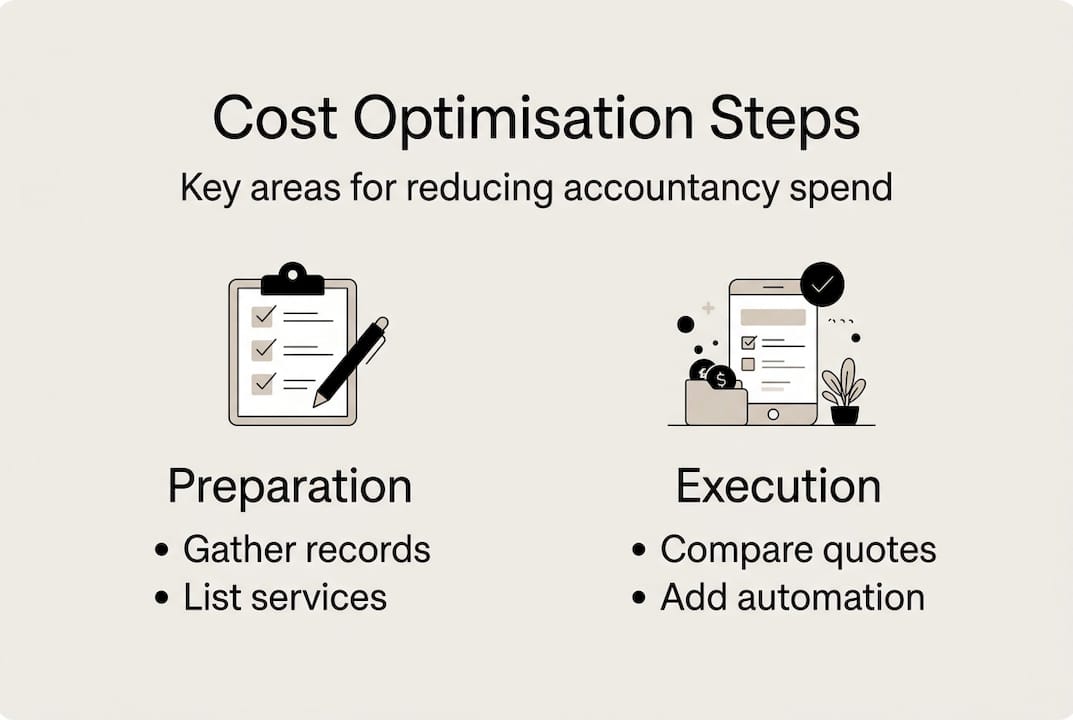
Effective cost optimisation begins long before you contact an accountant or review service agreements. Proper groundwork ensures you maximise value from every pound spent on professional services. Without preparation, you risk paying for hours your accountant spends organising information you should have ready.
Start by gathering all financial records into a centralised system. This includes invoices, receipts, bank statements, payroll records, and VAT documentation. Preparing organised financial documents before consulting reduces time and fees substantially. When your accountant can dive straight into analysis rather than data entry, you pay for expertise instead of administrative work.
Understanding basic accounting principles empowers you to ask relevant questions and identify unnecessary services. You do not need a degree in finance, but knowing the difference between management accounts and statutory accounts helps you specify exactly what you need. This knowledge prevents accountants from bundling services you could handle internally or simply do not require.
Set clear, measurable goals for your cost optimisation project. Vague intentions like "spend less" rarely succeed. Instead, target specific outcomes such as reducing monthly fees by 20% or cutting year end compliance costs by £500. Concrete targets let you evaluate whether strategies work and adjust your approach when needed.
Create a detailed inventory of your current accountancy services and associated fees. List every service separately:
- Monthly bookkeeping and reconciliation
- Quarterly VAT returns and submissions
- Annual accounts preparation and filing
- Tax planning consultations and advice
- Payroll processing and PAYE administration
- Ad hoc queries and email support
This breakdown reveals where money goes and highlights services you might consolidate, automate, or eliminate. Many LS25 businesses discover they pay for overlapping services or retain legacy arrangements no longer suited to their current size.
Finally, audit your internal resources and existing software. You might already own accounting tools with features you have never activated. Understanding what capabilities sit unused in your current setup prevents paying professionals for tasks your systems can handle. This assessment also identifies skill gaps in your team that training could fill, further reducing reliance on external support.
How to execute strategies to reduce accountancy costs effectively
With solid preparation complete, you can implement specific tactics that deliver measurable cost reductions. These steps work together as an integrated approach rather than isolated fixes.
Step one involves evaluating your current accountant fees against local alternatives. Request detailed quotes from at least three LS25 area firms, ensuring each proposal covers identical services for accurate comparison. Selecting the right accounting services balances cost and ensures quality financial management. Do not focus solely on headline rates because pricing structures vary widely. Some firms charge hourly, others offer fixed monthly packages, and many use hybrid models. Compare total annual costs rather than individual line items.
Step two requires implementing accounting software to automate routine tasks. Modern cloud based platforms handle invoice creation, expense tracking, bank reconciliation, and basic reporting without human intervention. These systems cost a fraction of professional fees for equivalent tasks. Choose software that integrates with your bank feeds and HMRC systems to eliminate double data entry. The upfront learning curve pays dividends within months as you reclaim hours previously billed by your accountant.

Step three focuses on proactive tax planning using structured checklists. Tax planning can significantly reduce professional accounting charges by preventing rushed year end work and penalty fees. Schedule quarterly tax reviews rather than waiting until January deadlines loom. This approach spreads workload evenly, reduces emergency consultation fees, and uncovers allowances or reliefs you might otherwise miss. Your accountant spends less time firefighting and more time adding strategic value.
Step four involves negotiating fee structures based on clear deliverables. Many accountants default to hourly billing, which creates uncertainty and can incentivise inefficiency. Propose fixed price agreements for predictable services like annual accounts or monthly bookkeeping. Define exactly what each package includes and excludes to avoid scope creep. Fixed fees give you budget certainty and motivate your accountant to work efficiently since extra hours do not generate extra revenue.
Step five centres on training internal staff to handle simpler accounting tasks. Payroll processing, invoice management, and basic reconciliation do not always require professional qualifications. Investing in employee training courses costs less than ongoing outsourced fees for routine work. Your team gains valuable skills while you reserve accountant time for complex issues requiring their expertise.
Pro Tip: Review your accounting software's feature list quarterly to discover capabilities you have not yet activated. Most platforms release updates regularly, adding automation that could replace manual processes or professional services you currently pay for separately.
The table below compares common cost saving approaches and their typical impact:
| Approach | Implementation effort | Typical annual savings | Best suited for | | --- | --- | --- | | Software automation | Medium | £1,200 to £3,000 | Businesses with regular transactions | | Selective outsourcing | Low | £800 to £2,000 | Companies with capable internal teams | | Fee negotiation | Low | £500 to £1,500 | Established client relationships | | Staff training | High | £1,500 to £4,000 | Growing businesses with dedicated finance roles |
Common mistakes and how to verify cost optimisation success
Even well intentioned cost cutting efforts can backfire without careful execution and ongoing monitoring. Understanding frequent pitfalls helps you avoid expensive mistakes disguised as savings.
Rushing negotiations without fully understanding your accounting needs ranks among the most damaging errors. Pressure to cut costs quickly leads business owners to accept proposals missing critical services or compliance requirements. You might save £100 monthly only to face £2,000 in penalties when VAT returns go unfiled or errors trigger HMRC investigations. Take time to map your genuine requirements before comparing quotes.
Sacrificing quality or compliance for the lowest possible cost creates false economy. The cheapest accountant rarely delivers the best value, especially for businesses with complex affairs or growth ambitions. Poor advice on tax planning, missed deadlines, or sloppy bookkeeping cost far more than the difference between budget and premium service providers. Prioritise competence and reliability over rock bottom pricing.
Several mistakes appear repeatedly across LS25 businesses attempting cost optimisation:
- Maintaining poor record keeping that forces accountants to spend extra hours reconstructing transactions
- Inconsistent communication leaving professionals guessing about your intentions or business changes
- Ignoring new tax laws and reporting requirements that affect your compliance obligations
- Failing to review service agreements annually as your business evolves
- Accepting generic advice instead of industry specific guidance tailored to your sector
Verifying optimisation success requires systematic measurement rather than gut feeling. Start by comparing invoices from before and after implementing changes. Calculate total accounting costs as a percentage of revenue to account for business growth. A 15% fee reduction means little if your turnover doubled, actually indicating costs rose relative to business size.
Monitor error rates in your financial records and compliance submissions. Reviewing accounting practices regularly can cut errors and extra charges by 30%. Increased mistakes signal that cost cutting compromised quality. Track metrics like VAT return amendments, late filing penalties, and HMRC queries to quantify accuracy trends.
Compare pre and post optimisation cost levels across multiple dimensions. Look beyond total fees to examine cost per transaction, cost per employee, and cost per compliance event. This granular analysis reveals whether savings came from genuine efficiency or simply doing less work.
Pro Tip: Schedule quarterly reviews with your accountant to catch issues early and discuss whether current arrangements still fit your needs. These check ins cost little but prevent small problems escalating into expensive corrections.
The comparison table below illustrates common mistakes alongside corrective actions:
| Mistake | Corrective action | Outcome improvement |
|---|---|---|
| Choosing cheapest provider | Evaluate competence and references | Fewer errors, better compliance |
| No service agreement review | Annual contract assessment | Services match current needs |
| Poor internal records | Implement organised filing system | Lower billable hours |
| Reactive tax approach | Quarterly planning sessions | Reduced penalties and stress |
Explore expert LS25 accountancy solutions
Optimising accountancy costs yourself delivers significant savings, but partnering with specialists accelerates results and reduces trial and error. LS25 Accountants provide tailored services for businesses across Garforth, Kippax, and the wider LS25 area, combining local knowledge with technical expertise. Their team understands regional business challenges and regulatory nuances affecting your bottom line.
They offer practical cost saving strategies, proactive tax planning, and efficient financial management frameworks designed specifically for LS25 enterprises. Whether you need comprehensive support or targeted advice on specific issues, their expert articles and guides help you make informed decisions about your accounting spend. Leveraging professional guidance ensures you reduce fees without compromising the quality or compliance that protects your business long term.
How to optimise accountancy costs: frequently asked questions
What is the first step in reducing accountancy costs?
Begin by organising all financial records and creating a detailed inventory of current services and fees. This preparation lets you identify exactly where money goes and which tasks you might handle internally or automate. Without clear visibility into your existing spend, you cannot make informed decisions about where to cut costs effectively.
How often should I review my accounting service fees?
Conduct a comprehensive review annually, ideally before renewing service agreements or at your financial year end. Quarterly check ins with your accountant help catch emerging issues and ensure services still match your evolving needs. Regular reviews prevent paying for outdated arrangements that no longer suit your business size or complexity.
Can software really replace some accountant tasks?
Yes, modern accounting software automates routine tasks like invoice creation, expense tracking, bank reconciliation, and basic reporting. These platforms handle repetitive work accurately and cost far less than professional fees for equivalent services. However, software cannot replace strategic advice, complex tax planning, or compliance interpretation where professional judgement matters.
How does tax planning influence accountancy costs?
Proactive tax planning spreads workload evenly throughout the year, reducing expensive rushed work near deadlines. It also helps you claim all available allowances and reliefs, potentially lowering your tax bill substantially. Regular planning sessions cost less than emergency consultations and prevent penalty fees from missed deadlines or incorrect submissions.
What are warning signs of overpriced accounting services?
Watch for vague invoices lacking task breakdowns, frequent additional charges beyond quoted fees, slow response times suggesting inefficient work practices, and reluctance to explain billing or discuss alternatives. If your accountant cannot clearly justify costs or resists transparency about how time is spent, you likely pay more than necessary for the value received.