
UK businesses risk penalties up to 100% of tax due by neglecting regular accounting reviews. Accounting practice reviews are essential for regulatory compliance and financial accuracy. Many UK business owners underestimate the frequency and scope needed for effective reviews. This guide covers why and how you should regularly review your accounting practices to avoid costly errors and penalties.
Table of Contents
- Introduction To Accounting Practice Reviews
- Why Regular Reviews Are Essential For Regulatory Compliance
- Improving Financial Accuracy And Error Detection
- Enhancing Risk Management And Fraud Prevention
- Optimizing Efficiency And Operational Improvements
- Common Misconceptions And Corrective Insights
- Comparing In-House And Outsourced Accounting Reviews
- Implementing Effective Accounting Practice Reviews With Expert Support
- Get Expert Support For Your Accounting Practice Reviews
Key Takeaways
| Point | Details |
|---|---|
| Regular reviews reduce discrepancies | Quarterly accounting reviews reduce potential financial discrepancies by 30% compared to annual checks. |
| Compliance protection | Reviews keep businesses aligned with evolving UK tax laws and prevent hefty HMRC penalties. |
| Fraud detection | Systematic evaluations help detect and prevent fraud, enhancing risk management capabilities. |
| Operational efficiency | Reviews identify inefficiencies and support better strategic decisions. |
| Outsourcing benefits | Professional reviews reduce compliance errors by 25% compared to in-house only approaches. |
Introduction to Accounting Practice Reviews
Accounting practice reviews are periodic evaluations that ensure compliance, accuracy, and operational efficiency. They provide a structured way to catch errors, maintain audit readiness, and update controls. Regular reviews align financial management with current HMRC regulations to avoid penalties.
These reviews are more than just compliance exercises. They assess whether your accounting processes deliver accurate financial data, comply with UK laws, and function efficiently. When conducted properly, reviews reveal gaps in your controls and opportunities to improve workflows.
Expected prerequisites include:
- Accurate recordkeeping systems that track all financial transactions
- Understanding of UK tax law requirements relevant to your business structure
- Willingness to implement improvements identified during the review process
- Commitment to regular scheduling rather than sporadic checks
Without these foundations, reviews lose effectiveness. You need to treat accounting reviews as an investment in business health, not a burden. LS25 Accountants expert guides provide detailed frameworks for implementing effective review processes.
Why Regular Reviews Are Essential for Regulatory Compliance
HMRC penalties can reach up to 100% of tax due for non-compliance without proper accounting reviews. Tax regulations frequently change; regular reviews keep businesses in line with current laws. Accounting reviews improve audit readiness, reducing risk of HMRC investigation.
Quarterly reviews are more effective than annual-only checks at catching compliance risks early. When you wait a full year between reviews, small compliance issues compound into major problems. Identifying and correcting issues quarterly prevents costly penalties and protects your business reputation.
Key compliance benefits include:
- Early detection of tax calculation errors before filing deadlines
- Verification that all required documentation meets HMRC standards
- Confirmation that VAT treatment aligns with current legislation
- Assurance that payroll and employer obligations are correctly managed
"Regular corporate tax planning strategies integrated with accounting reviews create a powerful compliance shield for UK businesses."
Businesses that embrace systematic reviews demonstrate proactive compliance. This approach significantly reduces the likelihood of HMRC scrutiny. Understanding tax compliance and review importance helps you appreciate how structured processes protect your business.
Improving Financial Accuracy and Error Detection
Manual errors affect up to 5% of accounting entries in small UK businesses. Accounting errors commonly arise from manual data entry and lack of reconciliation. Regular reviews can identify and correct errors early, preventing costly misstatements.

Accurate financial data aids more reliable forecasting, budgeting, and strategic decisions. When your numbers are wrong, every business decision built on those numbers is compromised. Reviews act as quality control checkpoints that verify data integrity.
Error reduction improves confidence among stakeholders including banks and investors. Lenders scrutinize your financial statements before approving credit. Investors evaluate your books before committing capital. Clean, accurate records facilitated by regular reviews strengthen your position with all external parties.
Common error sources addressed by reviews:
- Transposition errors in data entry that distort account balances
- Missing transactions that understate revenue or overstate profit
- Incorrect categorization that misrepresents financial position
- Bank reconciliation gaps that hide cash discrepancies
Implementing cash flow management strategies alongside regular reviews creates a robust financial management system. You catch errors before they cascade through your financial statements and strategic planning.
Enhancing Risk Management and Fraud Prevention
Structured review processes increase fraud detection and reduce compliance risks. Fraud risks include asset misappropriation and financial statement manipulation. Regular reviews enable early detection through anomaly identification and control assessment.
Implementing layered control measures as part of review improves overall risk management. When multiple control layers operate together, fraud becomes significantly harder to perpetrate and conceal. Reviews test whether your controls actually function as designed or exist only on paper.
Effective fraud prevention through reviews includes:
- Analyzing unusual transaction patterns that deviate from historical norms
- Verifying segregation of duties to prevent single-person control over processes
- Testing authorization controls to ensure proper approval hierarchies
- Reviewing access logs to detect unauthorized system entry
Pro Tip: Use data analytics tools during reviews to spot unusual patterns indicative of fraud. Modern software can flag anomalies that human reviewers might miss during manual inspection.
Small businesses often assume fraud only happens in large corporations. The reality contradicts this assumption. Small UK businesses face fraud risk proportional to their control weaknesses. Regular accounting reviews conducted by fraud detection insights experts strengthen your defense against internal and external threats.
Optimizing Efficiency and Operational Improvements
Reviews identify time-consuming manual tasks suitable for automation. Streamlining accounting workflows reduces operational costs and speeds up reporting. Automation reduces errors and frees up staff for more strategic activities.
Businesses implementing reviews report administrative savings up to 20%. These savings come from eliminating redundant processes, automating routine tasks, and improving data flow between systems. When your accounting processes run efficiently, your team spends less time on data entry and more time on analysis.
Operational improvements discovered through reviews:
- Duplicate data entry eliminated through system integration
- Report generation automated instead of manual compilation
- Invoice processing accelerated through workflow optimization
- Month-end close procedures shortened by addressing bottlenecks
Understanding efficiency benchmarks and automation benefits helps you set realistic improvement targets. Reviews provide the diagnostic information you need to prioritize which inefficiencies to address first.
Concorde Company Solutions Limited specializes in identifying these operational opportunities during accounting reviews. Their expertise helps you implement practical improvements that deliver measurable results without disrupting daily operations.
Common Misconceptions and Corrective Insights
Myth: Annual reviews are sufficient. Fact: Quarterly reviews reduce discrepancies by 30% compared to annual checks. Many business owners believe one comprehensive annual review provides adequate oversight. The evidence contradicts this belief.
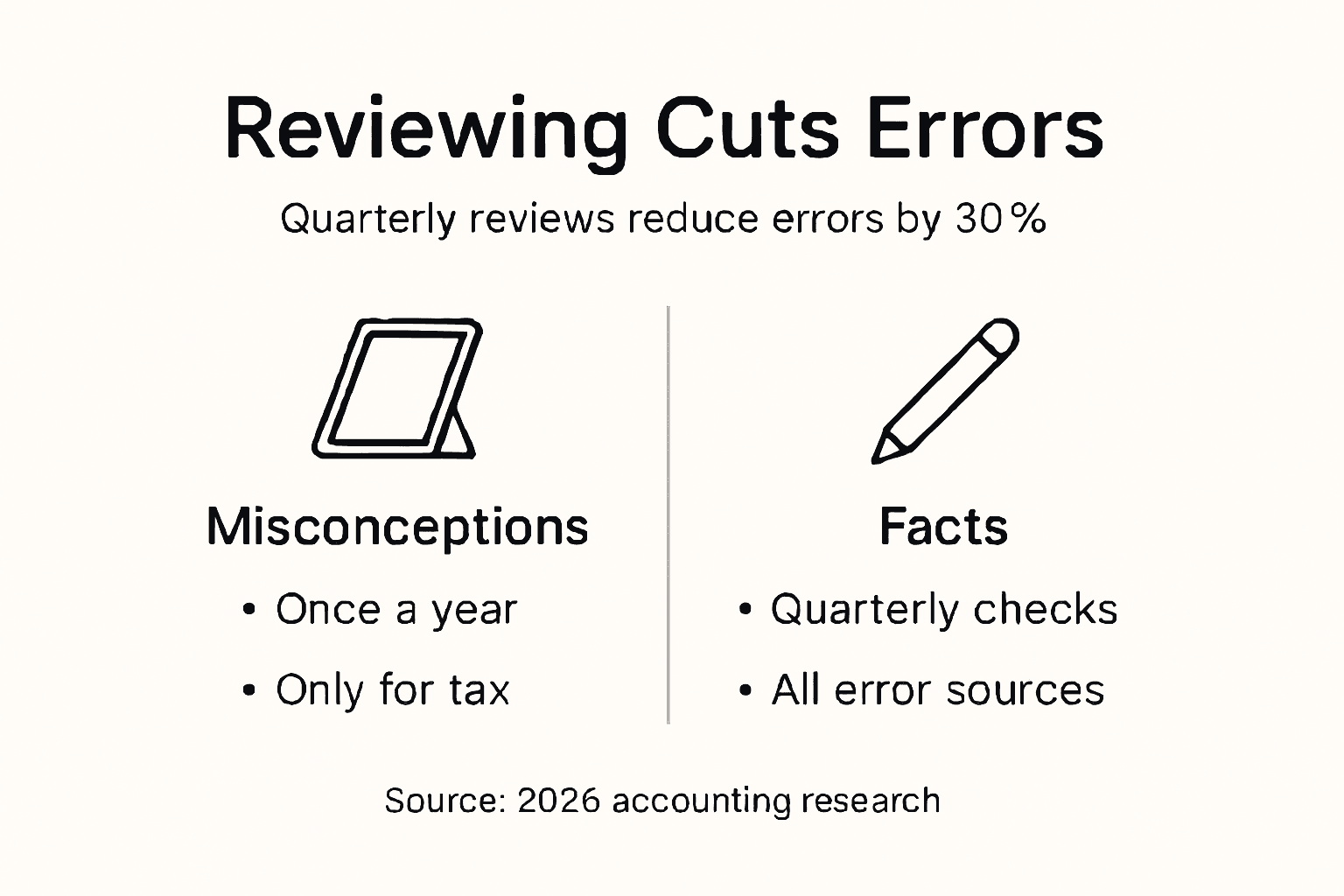
Myth: Reviews only needed when laws change. Fact: Over 50% of errors are unrelated to legislation updates. Errors arise from process breakdowns, human mistakes, and system failures regardless of regulatory changes. Waiting for law changes means ignoring the majority of error sources.
Myth: In-house reviews are always superior. Fact: Outsourcing reduces compliance errors by 25% through expert objectivity and specialized knowledge. Internal teams bring valuable business context but may lack the technical depth or independence that external experts provide.
Common misunderstandings about review scope:
- Believing reviews only check mathematical accuracy ignores compliance and efficiency aspects
- Assuming reviews are punitive rather than improvement focused creates resistance
- Thinking reviews are only for large businesses leaves small firms vulnerable
- Viewing reviews as optional regulatory extras rather than core business practice
Pro Tip: Combine in-house periodic checks with expert outsourced audits for optimal results. This hybrid approach leverages internal knowledge while gaining external perspective and specialized expertise.
Comparing In-House and Outsourced Accounting Reviews
Outsourcing accounting reviews reduces compliance errors by 25% compared to in-house only approaches. In-house reviews offer lower direct costs and better internal knowledge but limited expertise. Outsourced reviews provide greater expertise, objectivity, and reduced compliance risk at higher cost.
| Aspect | In-House Reviews | Outsourced Reviews |
|---|---|---|
| Cost | Lower direct costs | Higher fees but potential savings from error prevention |
| Expertise | Limited to staff knowledge | Access to specialized accounting and tax experts |
| Objectivity | Potential bias from internal relationships | Independent perspective on processes and controls |
| Compliance Risk | Higher due to knowledge gaps | Lower through expert awareness of regulations |
| Implementation Speed | Faster for simple checks | May require initial setup but delivers comprehensive coverage |
Small businesses with limited staff often benefit more from outsourcing. When your team already operates at capacity, adding review responsibilities stretches resources and increases burnout risk. Medium-sized businesses may combine both approaches for comprehensive coverage.
Concorde Company Solutions Limited offers flexible review arrangements that adapt to your business size and needs. Their approach combines the efficiency of professional expertise with understanding of your specific business context. Explore accounting review options guide to determine which model suits your situation.
Implementing Effective Accounting Practice Reviews with Expert Support
Regular scheduling, structured frameworks, and expert involvement maximize the value of accounting reviews. Schedule reviews quarterly to balance timely insights and resource efficiency. Quarterly timing catches issues before they compound while avoiding the resource drain of monthly formal reviews.
Use a framework focusing on compliance, accuracy, risk, and efficiency during reviews. This structured approach ensures you address all critical areas rather than conducting ad hoc checks. Each review should systematically examine whether your accounting meets standards in these four dimensions.
Implementation steps for effective reviews:
- Establish a review calendar with specific dates for quarterly assessments
- Define clear objectives and scope for each review cycle
- Gather necessary documentation including financial statements and transaction records
- Conduct systematic evaluation using your chosen framework
- Document findings with specific recommendations for improvement
- Implement corrective measures promptly and track progress
Evaluate findings promptly and implement corrective or improvement measures. Delayed action undermines the entire review process. When you identify an issue, address it immediately rather than waiting for the next review cycle.
Consider periodic outsourcing to gain expert perspectives and reduce oversight risks. Even if you conduct most reviews in-house, annual or semi-annual external reviews provide valuable independent validation.
Pro Tip: Engage Concorde Company Solutions Limited for tailored accounting reviews and expert guidance. Their specialized knowledge of UK regulations and LS25 area business needs makes them ideally positioned to support your accounting excellence. Visit expert accounting support to learn more about their comprehensive review services.
Get Expert Support for Your Accounting Practice Reviews
Partnering with experts like Concorde Company Solutions Limited ensures thorough accounting practice reviews. Professional reviews enhance compliance, reduce error risks, and optimize financial operations. Their team brings deep expertise in UK accounting standards and practical experience with businesses across the LS25 area.
Concorde Company Solutions Limited tailors reviews to your specific business structure, industry, and growth stage. They don't apply generic checklists but instead develop customized frameworks that address your unique risks and opportunities. This personalized approach delivers actionable insights rather than theoretical recommendations.
LS25 Accountants services provide tailored guidance to support UK businesses in meeting 2026 regulatory demands. Their comprehensive approach integrates accounting reviews with corporate tax planning advice for complete financial management support. You gain a trusted partner who understands both compliance requirements and strategic business needs.
Frequently Asked Questions
Why should UK business owners review accounting practices regularly?
Regular reviews keep financial records accurate, compliant, and ready for audits. They detect errors and fraud risks early, preventing costly penalties and losses. Quarterly reviews balance resource efficiency with timely oversight.
How often should accounting practice reviews occur?
Quarterly reviews are generally recommended to balance resource use and oversight. This frequency catches issues early while avoiding the administrative burden of monthly formal reviews. Annual reviews alone miss too many problems.
What are the main benefits of outsourcing accounting reviews?
Outsourcing provides specialized expertise, independent objectivity, and reduced compliance errors by 25% compared to in-house only. External experts bring current knowledge of regulations and best practices that internal teams may lack. This approach particularly benefits small businesses without dedicated accounting staff.
Can accounting reviews really reduce errors by 30%?
Yes, quarterly reviews reduce financial discrepancies by 30% compared to annual-only checks according to research data. More frequent reviews catch errors when they occur rather than allowing them to compound. This proactive approach significantly improves data quality.
How does Concorde Company Solutions Limited support accounting reviews?
Concorde Company Solutions Limited offers tailored review services that address compliance, accuracy, risk, and efficiency. Their expertise in UK regulations and local business needs ensures comprehensive, practical assessments. They partner with you to implement improvements that deliver measurable results in your financial management.
Recommended
- Corporate Tax Planning Strategies: Cut Liabilities by 15% in 2026
- LS25 Accountants | Expert Articles & Accountancy Guides for Garforth, Kippax & LS25 Area
- Cash Flow Management: Key Strategies for Stability
- How to Manage Cash Flow for Lasting Business Stability
- How to Optimize Trading Decisions for Quantitative Edge - My Framer Site