
Managing VAT compliance and MTD ITSA requirements can feel overwhelming for LS25 business owners, especially when manual processes lead to costly mistakes. Many small businesses risk penalties simply because they lack the right digital tools or clear guidance. Recent studies show that automated accounting software can reduce VAT filing errors by up to 30%, transforming compliance from a burden into a streamlined process. This guide will teach you how to prepare your business taxes accurately for 2026, stay compliant with HMRC regulations, and maximise deductions.
Table of Contents
- Prerequisites For Effective Tax Preparation
- VAT Registration And Compliance Requirements
- Making Tax Digital (MTD) Compliance For ITSA
- Stepwise VAT Return Preparation And Submission
- Maximising Business Expense Deductions
- Common VAT Filing Mistakes And Penalty Avoidance
- Expected Outcomes And Compliance Benchmarks
- Ready To Simplify Your LS25 Business Tax Preparation?
- Frequently Asked Questions
Key Takeaways
| Point | Details | |-------|---------|| | VAT Registration Threshold | Mandatory registration required at £90,000 turnover within any 12 months. | | MTD ITSA Digital Filing | Sole traders earning over £50,000 must comply from April 2026. | | Error Reduction | MTD-compliant software cuts filing mistakes and automates submissions. | | Penalty Avoidance | Timely VAT returns prevent HMRC fines and interest charges. | | Deduction Optimisation | Proper documentation and input VAT recovery lower your tax burden. |
Prerequisites for Effective Tax Preparation
Before you start preparing your 2026 tax returns, you need the right foundation. Understanding your obligations and having the proper tools ensures compliance and prevents costly mistakes down the line.
First, you must know the £90,000 VAT registration threshold. Missing this deadline triggers automatic penalties. Second, HMRC requires MTD-compatible digital accounting software for all VAT-registered businesses. Manual spreadsheets no longer meet legal standards. Third, familiarise yourself with UK VAT rates and rules, including standard, reduced, and zero rates that apply to different goods and services.
You also need accurate annual turnover data and realistic projections. Without this, you cannot determine when registration becomes mandatory or plan cash flow effectively. Finally, your digital record-keeping systems must meet HMRC audit requirements, storing transaction data securely for at least six years.
Essential preparation steps include:
- Verify your business turnover against the £90,000 threshold monthly
- Install MTD-compatible accounting software approved by HMRC
- Review current VAT rates applicable to your products or services
- Set up digital invoicing and receipt capture systems
- Consult accountancy guides for LS25 area businesses to understand local compliance trends
Pro Tip: Start tracking your turnover three months before you approach the £90,000 threshold. This gives you time to register without rushing and potentially missing the 30-day deadline.
VAT Registration and Compliance Requirements
Once you understand your prerequisites, focus on the actual registration process and ongoing compliance obligations. Getting this right prevents penalties and ensures smooth operations.
VAT registration becomes mandatory when your taxable turnover exceeds £90,000 within any consecutive 12 months. You have exactly 30 days from the date you exceed this threshold to register with HMRC. Late registration triggers automatic penalties starting at £400, escalating based on how long you delay.
Voluntary registration below the threshold can benefit certain businesses. If you sell mainly to VAT-registered businesses, you can reclaim input VAT on purchases and expenses. However, this adds administrative work including quarterly returns and digital record-keeping.
Key registration requirements include:
- Monitor rolling 12-month turnover continuously, not just annually
- Register online through HMRC Gateway within 30 days of crossing the threshold
- Obtain your VAT registration number and display it on all invoices
- Set up quarterly return submission schedules aligned with your accounting periods
- Understand special rules for overseas sales and Northern Ireland transactions
HMRC enforces strict deadlines. Miss your registration window, and you face immediate fines plus interest on unpaid VAT from the date you should have registered. For businesses operating near the threshold, consider seeking VAT registration guidance from local experts who understand LS25-specific trading patterns.
Pro Tip: If your turnover fluctuates seasonally, track it on a rolling basis rather than calendar year. This prevents surprise threshold breaches during peak trading months.
Making Tax Digital (MTD) Compliance for ITSA
Beyond VAT, 2026 brings mandatory digital reporting for income tax through Making Tax Digital for Income Tax Self Assessment. Understanding these rules protects you from non-compliance penalties.
MTD ITSA became mandatory from April 2026 for sole traders with annual business or property income exceeding £50,000. This system requires you to keep digital records and submit quarterly updates directly to HMRC through compatible software. Manual records and annual paper tax returns no longer suffice.
The system links your accounting software directly to HMRC systems. Every transaction flows digitally, reducing errors from manual data entry. However, failing to comply triggers penalties under HMRC's points-based system, where repeated failures accumulate points leading to fixed fines.
Compliance steps include:
- Choose software from HMRC's approved list that integrates with your existing systems
- Migrate all business records to digital record-keeping requirements format
- Submit quarterly summaries of income and expenses within specified deadlines
- File your final tax return annually, combining all quarterly submissions
- Maintain digital audit trails for all transactions and adjustments
Transitioning to MTD takes time and planning. Start at least three months before your compliance deadline. Explore MTD for ITSA compliance strategies that fit your business structure and income levels. Concorde Company Solutions Limited offers LS25-specific implementation support that simplifies this transition significantly.
Stepwise VAT Return Preparation and Submission
Now that you understand registration and MTD requirements, learn the practical process for preparing and submitting accurate VAT returns on time.
Keeping fully digital, MTD-compatible VAT records and timely quarterly submissions reduces filing errors substantially. Follow this structured approach:
- Maintain digital transaction records: Every sale and purchase must be recorded in MTD-compatible software immediately. Delayed entry increases error risk.
- Categorise transactions correctly: Assign the right VAT rate to each transaction. Mixing standard, reduced, and zero-rated items causes filing mistakes.
- Reconcile records monthly: Compare bank statements with software records to catch discrepancies early, not during quarterly deadline rushes.
- Generate VAT returns through software: Let your accounting system calculate totals automatically. Manual calculations introduce errors.
- Review returns before submission: Check for unusual figures, missing invoices, or miscategorised transactions that could trigger HMRC queries.
- Submit electronically before deadlines: File at least two days before the due date to avoid last-minute technical issues.
| Task | Frequency | Deadline |
|---|---|---|
| Record transactions | Daily | Same day |
| Reconcile accounts | Monthly | Month end |
| Generate VAT return | Quarterly | 1 week before due date |
| Submit to HMRC | Quarterly | Calendar month + 7 days after period end |
| Pay VAT owed | Quarterly | Same as submission deadline |
Automated systems handle calculations and deadlines, but you must review outputs. Software cannot spot industry-specific anomalies or unusual transaction patterns. For comprehensive support with timely VAT returns preparation, Concorde Company Solutions Limited provides quarterly review services tailored to LS25 businesses.
Pro Tip: Set calendar reminders two weeks before each VAT deadline. This buffer prevents rushed submissions and gives you time to resolve any software or data issues.
Maximising Business Expense Deductions
After mastering submission mechanics, focus on reducing your tax liability through legitimate deductions and input VAT recovery.

Input VAT on business expenses can be reclaimed following partial exemption rules and requires proper documentation. Understanding what qualifies saves significant money.
You can recover input VAT on:
- Business goods and services purchased for taxable supplies
- Equipment, tools, and machinery used exclusively for business operations
- Professional services including accounting, legal advice, and consultancy
- Vehicle running costs where business use exceeds personal use
- Utilities and rent for business premises or home office portions
Partial exemption applies when you mix business and personal use. For home offices, calculate the business proportion of total space and utilities. For vehicles, maintain mileage logs separating business from personal journeys. HMRC scrutinises these claims, so detailed records prove essential.
Recent changes include specific VAT relief options for energy-saving equipment and charitable donations. Check current exemptions annually, as government policy evolves.
Keep digital copies of all invoices showing VAT separately. Missing documentation means forfeiting legitimate deductions during audits. Concorde Company Solutions Limited helps LS25 businesses identify overlooked deductions through detailed expense reviews, often uncovering thousands in recoverable VAT.
For expert VAT deduction tips specific to your industry, consult professionals who understand sector-specific rules and HMRC expectations.
Common VAT Filing Mistakes and Penalty Avoidance
Even with good systems, certain mistakes plague small businesses repeatedly. Recognising and preventing these errors protects your bottom line.
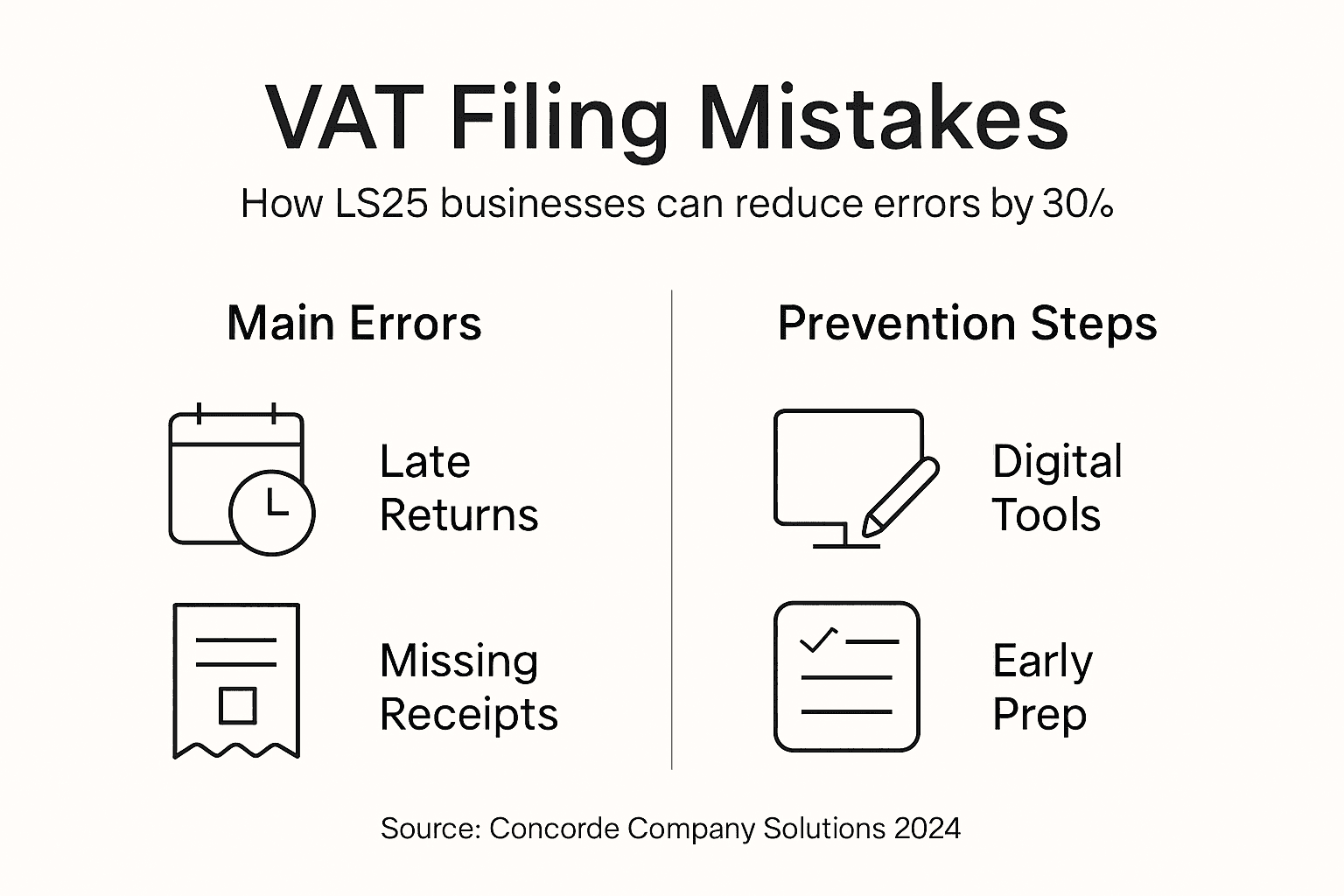
Errors such as incorrect VAT rates, late submissions, and missing digital records increase penalty risks substantially. HMRC's points-based penalty system punishes repeated failures harshly.
Most common mistakes include:
- Applying wrong VAT rates to specific products or services
- Missing registration deadline when turnover crosses £90,000
- Failing to link digital records properly to MTD systems
- Submitting returns late due to poor deadline management
- Claiming input VAT without proper supporting invoices
- Forgetting to account for reverse charge VAT on certain services
HMRC now operates a points system where each late filing or payment adds points. Accumulate enough points within a rolling period, and you face fixed penalties starting at £200, escalating with repeated violations. Digital compliance failures attract separate fines.
Automated digital accounting software reduces human error significantly. Businesses using integrated systems report approximately 30% fewer filing mistakes compared to manual processes.
To reduce VAT filing errors, implement these safeguards:
- Use software alerts for approaching deadlines
- Enable automatic VAT rate assignment based on product codes
- Schedule monthly reconciliation sessions to catch errors early
- Maintain complete digital audit trails for all transactions
- Review HMRC VAT compliance guidelines annually for rule changes
When mistakes occur, correct them immediately through HMRC's online correction process. Prompt voluntary disclosure reduces penalties compared to HMRC discovering errors during audits. For robust penalty avoidance strategies, Concorde Company Solutions Limited offers compliance monitoring that flags potential issues before they become costly problems.
Expected Outcomes and Compliance Benchmarks
Following this guide's strategies produces measurable results. Understanding realistic benchmarks helps you evaluate your tax preparation effectiveness.
Regular reconciliation and automated filing increase compliance success rates by over 85% and reduce errors by about 30%. These aren't theoretical numbers but outcomes observed across thousands of small businesses implementing proper digital systems.
Businesses that adopt MTD-compatible software and maintain consistent processes achieve:
- Zero late filing penalties through automated deadline tracking
- Significant reduction in HMRC enquiries due to accurate, consistent returns
- Faster input VAT recovery improving monthly cash flow
- Lower professional fees from reduced error correction work
- Better financial visibility supporting strategic business decisions
| Compliance Metric | Manual Process | Automated Digital Process |
|---|---|---|
| Filing errors per year | 4-6 instances | 1-2 instances |
| Late penalties incurred | £400-£1,200 | £0 |
| Time spent on VAT admin monthly | 8-12 hours | 2-4 hours |
| HMRC enquiry rate | 15% | 3% |
| Input VAT recovery speed | 45-60 days | 7-14 days |
These benchmarks represent achievable standards for LS25 businesses. Compare your current performance against these metrics. Significant gaps indicate opportunities for process improvement.
On-time registration and returns eliminate penalty exposure entirely. Proper deduction claims can reduce overall tax liability by thousands annually, depending on your business size and expense structure. Consistency matters more than perfection. Businesses maintaining steady compliance habits outperform those making sporadic efforts.
Concorde Company Solutions Limited helps LS25 businesses track these metrics through quarterly compliance scorecards, ensuring you meet or exceed industry benchmarks consistently.
Ready to Simplify Your LS25 Business Tax Preparation?
Managing VAT compliance and MTD requirements becomes straightforward with expert support tailored to LS25 businesses. Professional accountants eliminate the confusion around digital filing, deadline management, and deduction optimisation.
Concorde Company Solutions Limited specialises in helping LS25 business owners master VAT and MTD compliance effortlessly. Their LS25 accounting services provide comprehensive support including software setup, quarterly reviews, and ongoing compliance monitoring. You get access to tailored digital tools and expert guidance that prevent penalties while maximising your legitimate deductions.
Partner with local experts who understand your specific challenges and regulatory environment. They improve accounting accuracy through systematic processes and proactive error prevention. Their proven strategies reduce your tax liabilities while freeing up valuable time you can reinvest in growing your business. Stop struggling with complex tax rules alone and start benefiting from professional expertise designed specifically for businesses like yours.
Frequently Asked Questions
What is the VAT registration threshold for LS25 businesses in 2026?
The mandatory VAT registration threshold remains £90,000 in taxable turnover within any rolling 12-month period. You must register within 30 days of exceeding this amount. Voluntary registration below this threshold is possible if it benefits your business model.
How does Making Tax Digital affect sole traders' tax submissions?
MTD ITSA requires sole traders earning over £50,000 annually to keep digital records and submit quarterly income updates through approved software starting April 2026. This replaces traditional annual paper tax returns with ongoing digital reporting directly to HMRC systems.
Which digital tools are best for MTD compliance in small businesses?
Choose software from HMRC's approved list that integrates with your existing systems. Popular options include Xero, QuickBooks, and Sage, each offering different features and pricing. LS25 tax advice from Concorde Company Solutions Limited helps you select software matching your specific business needs and budget.
What are the penalties for late VAT registration or filing?
Late VAT registration starts at £400 and escalates based on delay duration. Late filing triggers HMRC's points-based system, where accumulated points lead to £200 fixed penalties, increasing with repeated violations. You also owe interest on unpaid VAT from the date registration should have occurred.
How can I maximise my VAT deductions legally?
Claim input VAT on all eligible business expenses including equipment, professional services, utilities, and vehicle costs. Maintain detailed digital records with proper invoices showing VAT separately. Apply partial exemption rules correctly for mixed-use items. Regular professional reviews often identify overlooked deductions worth thousands annually.
Recommended
- Corporate Tax Planning Strategies: Cut Liabilities by 15% in 2026
- LS25 Accountants | Expert Articles & Accountancy Guides for Garforth, Kippax & LS25 Area
- Why Review Accounting Practices? Cut Errors by 30% in 2026
- Top 6 likesaccounting.com Alternatives 2026
- Global Tax Reporting: Avoid 75% Penalties in 2026 | Settel Blog | Settel
- Crypto Taxes in 2026 — What Every Trader Needs to Know — Solaria World Blog