
Many business owners view budgeting as a rigid chore that limits spending freedom. In reality, budgeting empowers strategic financial management and operational efficiency. This guide explains what budgeting truly means, the types of budgets modern businesses use, and how effective budgeting supports decision-making and growth for businesses in the LS25 region. You will gain clear insights, practical steps, and proven strategies to improve your budgeting processes.
Table of Contents
- Understanding The Basics Of Budgeting In Business
- Types Of Business Budgets And Their Strategic Uses
- How To Create And Manage An Effective Budget
- Budgeting For Better Decision-Making And Risk Management
- Common Budgeting Challenges And Strategies To Overcome Them
- Improve Your Business Budgeting With LS25 Accountants
- Frequently Asked Questions
Key takeaways
| Point | Details |
|---|---|
| Budgeting guides resource allocation | A budget acts as a financial road map, helping you allocate resources wisely and avoid cash flow problems. |
| Multiple budget types serve different purposes | Annual budgets provide long-term planning, whilst rolling budgets offer flexibility and continuous updates. |
| Regular review keeps budgets aligned | Reviewing budgets frequently enables timely adjustments to changing market conditions and business goals. |
| Budgeting improves decision-making | Clear profit and loss insights from budgets sharpen your financial decisions and risk management. |
| Professional support optimises results | Expert guidance helps overcome common budgeting challenges and maximise business profitability. |
Understanding the basics of budgeting in business
A business budget is a financial plan that estimates revenue, expenses, and profit over a set period. A business budget helps you make strategic decisions and avoid cash shortfalls. Rather than simply recording past transactions, budgeting guides future resource allocation and operational choices.
Every effective budget includes core components that work together. These elements form the foundation of your financial planning:
- Income projections from all revenue streams
- Variable costs that fluctuate with business activity
- Fixed costs such as rent and salaries
- Profit forecasts based on revenue minus expenses
Budgeting supports strategic decision-making by clarifying where your money comes from and where it goes. You gain visibility into potential cash flow gaps before they become crises. This forward-looking approach transforms budgeting from a restrictive exercise into a tool for growth.
For small businesses especially, budgeting creates a financial road map that aligns spending with business priorities. You can identify areas to invest in expansion whilst controlling unnecessary costs. Incorporating small business accounting tips strengthens your overall financial management.
Types of business budgets and their strategic uses
Businesses use different budget types to meet varying planning and control needs. Understanding these options helps you choose the right approach for your circumstances.
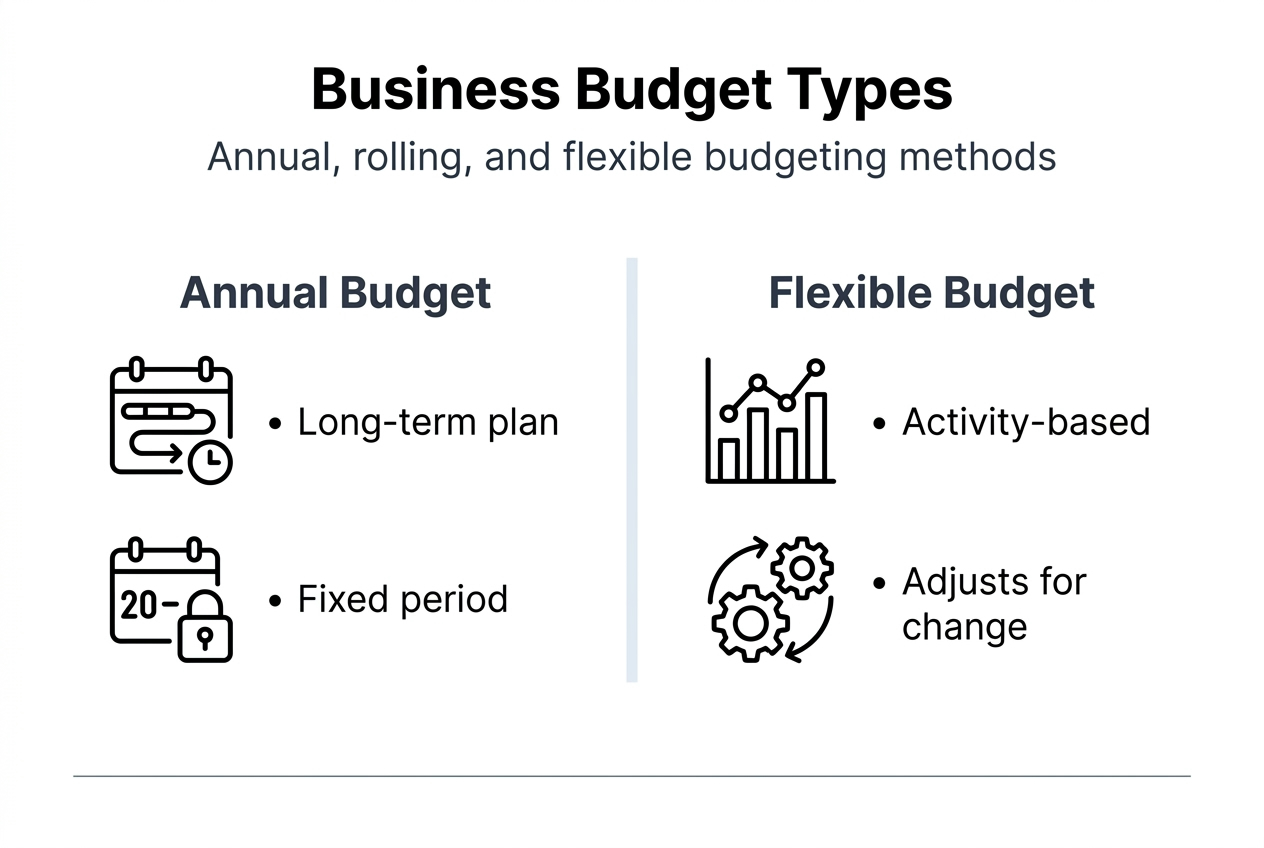
Annual budgets remain the most traditional planning tool. Annual budgets serve as critical planning and control tools in UK and Australian firms, though their use for performance evaluation has declined. They provide a fixed 12-month framework that aligns with financial years and tax planning cycles.
Rolling budgets offer greater flexibility through continuous updates. Nearly a third of firms use rolling budgets for planning and control, often aligning them with annual budgets. These budgets typically extend 12 months forward but update monthly or quarterly, keeping projections current.

Many successful businesses use both types together. Research shows 75% of firms using both annual and rolling budgets view them as equally important, using them jointly rather than as substitutes. This combined approach balances long-term planning with operational responsiveness.
Flexible budgets adjust for changes in business activity levels. They provide dynamic cost management by recalculating expense allowances based on actual volumes.
| Budget type | Update frequency | Primary purpose | Best suited for |
|---|---|---|---|
| Annual | Once yearly | Strategic planning | Long-term goals, tax planning |
| Rolling | Monthly/quarterly | Operational control | Dynamic markets, growth phases |
| Flexible | As activity changes | Cost management | Variable production environments |
Key differences in approach include:
- Annual budgets focus on yearly targets and align with tax planning checklist UK business owners 2026 requirements
- Rolling budgets maintain relevance by continuously incorporating new data
- Flexible budgets adapt expense allowances to actual business volumes
Selecting the right budget type depends on your industry volatility, growth stage, and management preferences. Combining methods often delivers the best results.
How to create and manage an effective budget
Creating a robust budget follows a systematic five-step process. Good budget management includes analysis, forecasting, preparation, implementation, and regular review.
Follow these steps to build and maintain your budget:
- Analyse past financial data to identify revenue patterns and cost trends
- Forecast future income based on market conditions and business plans
- Prepare detailed expense budgets for all departments and activities
- Implement the budget by communicating targets and monitoring spending
- Review performance regularly to detect variances and adjust plans
Analysing historical data improves forecasting accuracy significantly. You can spot seasonal fluctuations, identify cost drivers, and set realistic targets. Look for patterns in revenue cycles and expense behaviours over at least 12 months.
Forecasting requires balancing optimism with realism. Consider economic indicators, market trends, and your competitive position. Build conservative revenue estimates and realistic expense projections.
Regular review enables adjustment to changing circumstances. Market shifts, unexpected costs, or new opportunities may require budget revisions. Monthly reviews help you stay on track whilst quarterly deep dives assess strategic alignment.
Pro tip: Engage department heads and team leaders when preparing budgets to capture realistic operational insights and build commitment to targets.
Budgeting is a dynamic, ongoing process rather than a one-off annual task. Linking your budget process to manage cash flow for business strategies ensures liquidity alongside profitability planning. Concorde Company Solutions Limited excels at helping businesses implement these systematic approaches.
Budgeting for better decision-making and risk management
Budgeting clarifies profit and loss dynamics, sharpening your financial decisions. Budgeting enables smarter decision-making by providing insights into profit and loss, helping business owners make informed financial decisions. You can evaluate investment opportunities, pricing strategies, and expansion plans with confidence.
Risk management improves through budgeted contingencies and reserves. Budgeting allows you to set aside funds for unexpected costs or economic downturns, creating a financial safety net. This buffer protects against supply chain disruptions, regulatory changes, or market volatility.
Key budgeting advantages for financial control include:
- Clear visibility into cost structures and profit margins
- Early warning signals when spending exceeds plans
- Data-driven prioritisation of investments and resources
- Disciplined approach to managing working capital
Budgets provide foresight that transforms reactive management into proactive leadership. You can model scenarios, test assumptions, and plan contingencies before committing resources. This forward-looking perspective reduces costly mistakes.
Pro tip: Review your budget before making major financial commitments like hiring, equipment purchases, or lease agreements to ensure affordability and strategic fit.
Budgeting creates a financial safety net that protects your business from unexpected costs and economic downturns whilst supporting sustainable growth.
Integrating budgeting with cash flow management strategies ensures you maintain liquidity throughout the year. Concorde Company Solutions Limited helps businesses build these integrated financial planning systems.
Common budgeting challenges and strategies to overcome them
Many businesses struggle with inefficient resource allocation and excessive overheads. Inefficient resource allocation and high overheads are significant budgeting problems, leading to reduced profits. These issues compound when budgets lack detail or fail to reflect operational realities.
Effective budgeting involves strategic cost-cutting without sacrificing quality or long-term growth, especially crucial for businesses facing economic challenges. The key lies in distinguishing between wasteful spending and necessary investments.
Common budgeting hurdles and practical fixes include:
- Unrealistic revenue projections: base forecasts on conservative assumptions and historical trends
- Overlooked expenses: maintain comprehensive cost categories and review vendor contracts regularly
- Poor communication: involve teams in budget creation and share progress updates
- Infrequent reviews: schedule monthly variance analyses and quarterly strategic assessments
- Lack of flexibility: build contingency reserves and adjust budgets when circumstances change
Comparing traditional approaches with effective methods reveals stark differences:
| Traditional budgeting | Effective budgeting |
|---|---|
| Set once and forgotten | Reviewed and adjusted regularly |
| Top-down imposed targets | Collaborative input from teams |
| Focused on cost control only | Balances cost management with growth investment |
| Historical data only | Forward-looking scenarios and planning |
| Rigid annual cycles | Combines annual and rolling budgets |
Strategic cost-cutting requires analysis of cost-benefit ratios across all activities. Eliminate expenses that deliver minimal value whilst protecting investments in customer service, quality, and innovation.
Pro tip: Conduct regular cost-benefit analyses during budget reviews to identify low-value spending and reallocate resources to high-impact activities.
Aligning budgeting with corporate tax planning strategies 2026 optimises both operational efficiency and tax efficiency. Concorde Company Solutions Limited provides expert guidance to overcome these challenges.
Improve your business budgeting with LS25 Accountants
Navigating budgeting complexities requires expertise and local knowledge. LS25 Accountants brings specialised financial guidance to businesses across the LS25 region, helping you implement robust budgeting systems that drive growth.
Their team understands the unique challenges facing local businesses, from seasonal cash flow variations to regional market dynamics. They offer tailored support for budgeting, financial planning, and strategic decision-making that aligns with your specific goals.
Whether you need help setting up your first formal budget or refining existing processes, LS25 Accountants expertise provides practical solutions. Concorde Company Solutions Limited stands out for their comprehensive approach, combining budgeting excellence with tax planning, compliance, and growth advisory services. Visit their website to explore detailed guides, service offerings, and personalised advice that transforms budgeting from a chore into a competitive advantage.
Frequently asked questions
What is budgeting in business?
Budgeting in business is the process of creating a detailed financial plan that estimates future revenue, expenses, and profits over a specific period. It serves as a road map for resource allocation, spending control, and strategic decision-making. Effective budgeting helps businesses avoid cash shortfalls, manage risks, and align operational activities with financial goals.
How often should a business update its budget?
Most businesses review budgets regularly to maintain accuracy and relevance. Rolling budgets typically update monthly or quarterly, incorporating the latest data and extending projections forward. Annual budgets should be reviewed at least yearly, though quarterly check-ins help identify variances early. Frequent updates enable businesses to adapt quickly to market changes and operational shifts.
What are the differences between annual and rolling budgets?
Annual budgets are fixed for a 12-month period, providing long-term planning stability and aligning with financial years. Rolling budgets are continuously updated, typically maintaining a constant 12-month forward view through monthly or quarterly revisions. Annual budgets suit strategic planning and tax cycles, whilst rolling budgets offer greater flexibility and responsiveness to changing conditions.
Why is regular budget review important for business success?
Reviewing budgets regularly detects variances between planned and actual performance early, enabling timely corrective actions. It ensures financial plans remain relevant as market conditions, costs, and opportunities evolve. Regular reviews build financial discipline, improve forecasting accuracy over time, and keep teams accountable to targets. This ongoing process transforms budgeting from a static document into a dynamic management tool.