
Many UK business owners believe tax bands are straightforward percentages applied to income. In reality, the 2026/27 tax year introduces complexities that can dramatically increase your effective tax rate, particularly around the £100,000 mark where a hidden 60% marginal rate emerges. Understanding these nuances isn't just about compliance, it's about protecting your profits and making informed decisions about business structure, salary levels, and strategic planning. This guide breaks down the thresholds that matter most to self-employed individuals and limited company directors.
Table of Contents
- Overview Of Uk Tax Thresholds For 2026/27
- How Tax Thresholds Affect Self-Employed And Limited Company Owners
- Nuances And Special Cases In Tax Thresholds
- Practical Tips For Optimising Tax Obligations With Thresholds
- How Ls25 Accountants Can Support Your Tax Planning
Key takeaways
| Point | Details |
|---|---|
| Personal allowance frozen | The £12,570 personal allowance remains frozen until 2031, eroding real value through fiscal drag. |
| Hidden 60% tax trap | Incomes between £100,000 and £125,140 face effective 60% marginal rates due to allowance taper. |
| Structure matters | Limited companies typically offer better tax efficiency for profits between £50,000 and £100,000. |
| Trading allowance limits | The £1,000 trading allowance cannot be combined with expense claims and affects Universal Credit reporting. |
| Marginal relief incentive | Corporation tax marginal relief creates 26.5% effective rates, encouraging growth beyond £250,000. |
Overview of UK tax thresholds for 2026/27
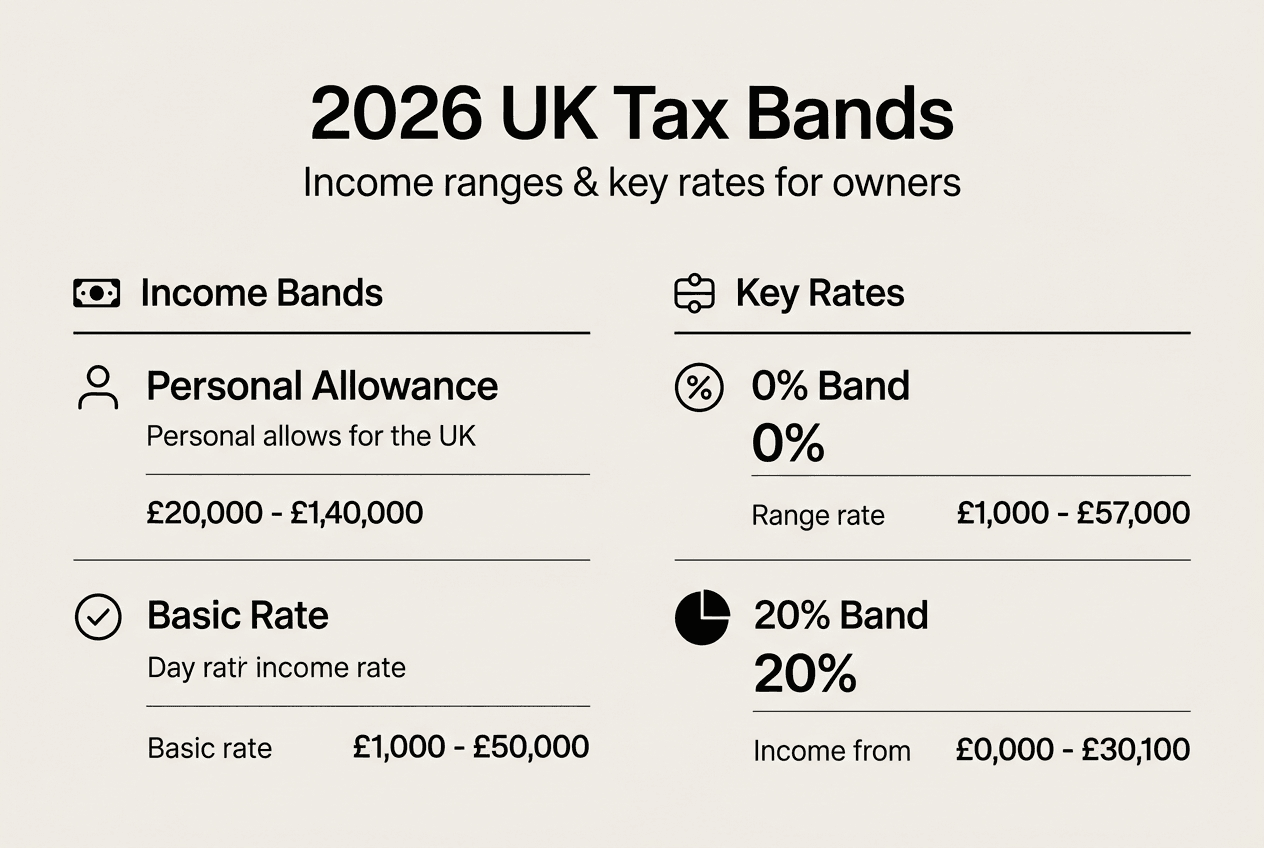
The UK tax system operates through a tiered structure where different portions of your income face different tax rates. For the 2026/27 tax year, the personal allowance is £12,570, frozen until 2031, with basic rate tax at 20% on income between £12,571 and £50,270. Higher rate taxpayers pay 40% on income from £50,271 to £125,140, whilst the additional rate of 45% applies to income exceeding this threshold.
This freeze creates fiscal drag, where inflation pushes more taxpayers into higher brackets without any real increase in purchasing power. For business owners planning salary and dividend strategies, these thresholds form the foundation of tax efficient decision making.
The personal allowance taper introduces a critical complication that many overlook. Once your adjusted net income exceeds £100,000, you lose £1 of personal allowance for every £2 earned above this threshold. By the time your income reaches £125,140, your personal allowance disappears entirely. This mechanism creates an effective marginal tax rate of 60% on income between these two points, a rate higher than even the additional rate band.
| Income band | Tax rate | Threshold range |
|---|---|---|
| Personal allowance | 0% | £0 to £12,570 |
| Basic rate | 20% | £12,571 to £50,270 |
| Higher rate | 40% | £50,271 to £125,140 |
| Additional rate | 45% | Above £125,140 |
| Taper zone | 60% effective | £100,000 to £125,140 |
Understanding these thresholds helps you identify opportunities for tax planning through pension contributions, income timing, and business structure choices. The frozen allowance means that without active planning, your tax burden will increase year on year even if your real income stays constant. Smart business owners use this knowledge to structure their affairs efficiently, ensuring they keep more of what they earn whilst maintaining full compliance.
Pro tip: Track your adjusted net income carefully as you approach £100,000. A small increase past this threshold can trigger disproportionate tax consequences.
For comprehensive strategies on reducing your tax burden, explore our tax deduction guide for 2026 which outlines allowable expenses and planning opportunities.
How tax thresholds affect self-employed and limited company owners
Your business structure fundamentally changes how tax thresholds impact your take home income. Self-employed individuals face income tax and National Insurance on all profits, whilst limited company directors can optimise through salary and dividend combinations that navigate threshold boundaries strategically.

The trading allowance offers self-employed individuals £1,000 of tax free trading income without needing to claim expenses. However, this creates a binary choice: you cannot claim the allowance and deduct expenses simultaneously. Approximately 33% of self-employed individuals use the trading allowance, making it a significant consideration for compliance and tax reporting. Universal Credit claimants cannot use this allowance and must report actual profits and expenses, adding complexity for those receiving benefits whilst building their business.
Limited companies often prove optimal for businesses earning £50,000 to £100,000 due to corporation tax rates and National Insurance savings, though dividend tax increases in 2026/27 narrow this advantage slightly. Directors typically draw a small salary up to the National Insurance threshold, then extract remaining profits as dividends taxed at lower rates than income tax. This structure becomes particularly valuable as profits approach higher rate thresholds.
Dividend tax rates increased by 2% in 2026/27, with basic rate dividend tax now at 8.75%, higher rate at 33.75%, and additional rate at 39.35%. These changes erode some advantages of incorporation, particularly for higher earners. Corporation tax marginal relief between £50,000 and £250,000 profits creates an effective marginal rate of 26.5%, incentivising businesses to push through this band towards the £250,000 threshold where the full 25% rate applies.
Self-employed structure:
- Simpler administration and lower compliance costs
- Direct access to all profits without dividend restrictions
- Higher National Insurance contributions on all profits
- Trading allowance available for small scale activities
- Income tax applied to all profits above personal allowance
Limited company structure:
- Corporation tax at 19% on profits up to £50,000, 25% above £250,000
- National Insurance savings through salary and dividend mix
- Dividend tax applies to distributions after corporation tax
- More complex administration and filing requirements
- Better pension contribution options for tax planning
Pro tip: Contribute to a pension scheme to reduce your adjusted net income below £100,000, avoiding the personal allowance taper whilst building retirement savings tax efficiently.
The choice between structures depends on profit levels, growth plans, and personal circumstances. For detailed guidance on when professional advice delivers measurable value, read why hiring a tax advisor can save 15% on UK business taxes. Understanding the benefits of tax planning for small businesses helps you make informed decisions about structure and strategy.
Nuances and special cases in tax thresholds
The personal allowance taper between £100,000 and £125,140 creates the most punishing marginal tax rate in the UK system. This mechanism produces a 60% effective marginal rate because you simultaneously pay 40% higher rate tax whilst losing personal allowance worth an additional 20% in tax. For every £100 earned in this band, you keep just £40.
This trap catches many business owners unaware, particularly those experiencing profit growth or one off income spikes. A bonus, dividend payment, or successful year can push you into this zone unexpectedly, creating a tax bill far higher than anticipated. Understanding this threshold allows you to plan income timing and structure to minimise exposure.
Steps to mitigate the personal allowance taper:
- Make pension contributions before the tax year ends to reduce adjusted net income below £100,000
- Time large income receipts across tax years to avoid bunching income in the taper zone
- Consider charitable donations through Gift Aid which reduce net income for taper calculations
- Defer bonuses or dividends if they would push income into the £100,000 to £125,140 band
- Utilise spousal income splitting where possible to keep both partners below the taper threshold
Associated companies rules complicate corporation tax thresholds for business owners with multiple entities. The £50,000 and £250,000 thresholds that determine corporation tax rates and marginal relief must be divided by the number of associated companies. Two associated companies would each have effective thresholds of £25,000 and £125,000, significantly reducing the benefit of marginal relief and potentially increasing overall tax liability.
Understanding the personal allowance taper is critical for accurate tax planning. The difference between £99,000 and £101,000 income isn't just £2,000 in tax, it's the start of a 60% marginal rate that can cost thousands in unexpected liability.
Universal Credit claimants face additional restrictions around tax thresholds and allowances. You cannot use the trading allowance if you claim Universal Credit, you must report actual business profits and expenses. This requirement ensures benefit calculations reflect true income, but it adds administrative burden for those building businesses whilst receiving support. Accurate record keeping becomes essential, as errors in reporting can lead to benefit overpayments that must be repaid.
These nuances demonstrate why threshold knowledge extends beyond simple rate application. The interaction between allowances, tapers, and business structures creates planning opportunities that can save thousands annually. For a comprehensive approach to navigating these complexities, review our tax planning checklist for UK business owners in 2026 and understand what tax compliance means for your business.
Practical tips for optimising tax obligations with thresholds
Knowing thresholds means nothing without actionable strategies to optimise your tax position. Business owners who actively plan around these boundaries consistently achieve lower effective tax rates whilst maintaining full compliance.
| Strategy | Best for | Tax saving potential |
|---|---|---|
| Pension contributions | High earners near £100k | Avoid 60% taper, gain tax relief |
| Salary/dividend mix | Limited company directors | Save 13.8% employer NI plus personal NI |
| Income timing | Variable profit businesses | Smooth income across tax years |
| Spousal income splitting | Couples with income disparity | Utilise both personal allowances fully |
| Trading allowance | Side income under £1k | Simplify reporting, reduce admin |
Timing income strategically around threshold boundaries delivers measurable benefits. If December earnings would push you into the personal allowance taper, deferring invoicing until January moves that income into the next tax year. This simple timing shift can save 20% in effective tax rate on that income. Similarly, bringing forward expenses into the current year reduces taxable profit, potentially keeping you below critical thresholds.
Tax optimisation tactics for threshold management:
- Review your projected income quarterly to identify threshold risks early
- Maximise pension contributions before 5 April to reduce adjusted net income
- Consider salary sacrifice arrangements that reduce taxable income efficiently
- Utilise all available allowances including trading allowance, dividend allowance, and savings allowance
- Time capital expenditure to optimise annual investment allowance claims
- Split income with family members through legitimate business arrangements where appropriate
- Review business structure annually as profit levels change and thresholds shift
Pro tip: Engage a qualified tax advisor before you approach £50,000 or £100,000 profit levels. The planning opportunities at these thresholds deliver returns that far exceed advisory fees.
Marginal relief creates an effective corporation tax rate of 26.5% for profits between £50,000 and £250,000, incentivising growth beyond the £250,000 threshold where the full 25% rate applies. This unusual structure means pushing through the marginal band can actually reduce your effective tax rate, rewarding business expansion. Understanding this dynamic helps you set growth targets that align with tax efficiency.
Record keeping underpins all threshold planning. HMRC requires businesses to retain records for at least six years, and comprehensive documentation supports both compliance and tax optimisation. Track income sources separately, categorise expenses accurately, and maintain evidence for all claims. This discipline ensures you can substantiate your position if questioned whilst identifying all available deductions.
Tax codes and thresholds change annually, making regular review essential. What worked in 2025/26 may not be optimal for 2026/27, particularly with frozen allowances and rising inflation. Schedule a tax planning review each January to assess the coming year's strategy, adjust estimated payments, and identify new opportunities. This proactive approach prevents surprises and maximises your after tax income.
For detailed implementation strategies, explore our guides on corporate tax planning to cut liabilities in 2026 and small business accounting tips for mastering payroll, VAT, and tax.
How LS25 Accountants can support your tax planning
Navigating UK tax thresholds requires expertise that goes beyond basic compliance. LS25 Accountants specialises in helping business owners and self-employed individuals across the LS25 area optimise their tax position through strategic planning tailored to your specific circumstances.
Our team understands the nuances of personal allowance tapers, corporation tax marginal relief, and business structure decisions that directly impact your bottom line. We provide personalised tax planning that identifies opportunities specific to your income level, growth trajectory, and business goals. From choosing between self-employment and incorporation to timing income around critical thresholds, we deliver actionable advice that reduces your tax burden legally and effectively.
Access our comprehensive library of expert guides and practical resources covering 2026 tax changes, compliance requirements, and optimisation strategies. Whether you're approaching a critical threshold or planning long term growth, our expertise ensures you make informed decisions that protect your profits whilst maintaining full compliance with HMRC requirements.
FAQ
What are tax thresholds and why are they important?
Tax thresholds determine the income levels at which different tax rates apply to your earnings. Understanding these boundaries helps you structure your income efficiently, avoid unexpected tax bills, and make informed decisions about business structure and salary levels. The 2026/27 thresholds include critical points at £50,270, £100,000, and £125,140 where effective tax rates change significantly.
How does the personal allowance taper affect high earners?
The personal allowance reduces by £1 for every £2 earned above £100,000, creating a 60% effective marginal tax rate between £100,000 and £125,140. This means you lose your entire £12,570 personal allowance by the time income reaches £125,140. Pension contributions, charitable donations, and income timing strategies can help you avoid this punishing rate whilst building wealth tax efficiently.
What is the trading allowance and who can use it?
The trading allowance lets you earn up to £1,000 tax free from self-employment or casual trading without claiming expenses or completing a full tax return. You cannot use it alongside expense claims, it's a binary choice between the allowance and actual expense deductions. Universal Credit claimants cannot use the trading allowance and must report actual profits and expenses for benefit calculations.
When should I consider limited company incorporation for tax reasons?
Limited companies typically deliver better tax efficiency for businesses earning £50,000 to £100,000 in annual profit due to lower corporation tax rates and National Insurance savings through salary and dividend combinations. However, dividend tax increases in 2026/27, administrative costs, and your specific circumstances all factor into this decision. Professional advice helps you evaluate whether incorporation suits your situation and timing.