
Nearly 1 in 7 UK payroll transactions contain errors that lead to costly compliance breaches and financial losses. Many business owners overlook the value of regular payroll audits, assuming they're only necessary when fraud is suspected. This guide explains why systematic payroll auditing is essential for compliance, accuracy, and fraud prevention, and provides a practical framework for implementing effective audits that protect your business and strengthen employee trust.
Table of Contents
- Introduction To Payroll Audits
- Legal And Regulatory Context For Payroll Audits In The UK
- Common Payroll Errors And Their Financial Impact
- How Payroll Audits Help Detect And Prevent Fraud
- Common Misconceptions About Payroll Audits
- Framework For Interpreting Payroll Audit Results
- Practical Steps For Conducting Payroll Audits
- Real-World Examples Of Payroll Audit Benefits
- Discover Tailored Payroll Audit Support With LS25 Accountants
- Frequently Asked Questions
Key takeaways
| Point | Details |
|---|---|
| Compliance assurance | Payroll audits ensure statutory compliance with UK payroll regulations including PAYE and National Insurance. |
| Error and fraud detection | Regular audits identify costly mistakes and fraudulent activities before they escalate into major financial losses. |
| Improved accuracy | Systematic reviews enhance payroll precision and build employee confidence in your payment processes. |
| Scalable solutions | Audit frameworks adapt to business size, making them practical for both small enterprises and large organisations. |
| Risk prioritisation | Structured audit approaches help focus resources on critical compliance and financial risks. |
Introduction to payroll audits
Payroll audits are systematic reviews of your payroll processes and records designed to verify accuracy and ensure compliance with UK statutory obligations. Rather than reactive measures triggered by suspicion, these audits serve as proactive controls that protect your business from costly errors and regulatory breaches. They examine everything from employee classifications and payment calculations to tax deductions and benefit administration.
The primary purpose of payroll audits extends beyond simply catching mistakes. They help ensure your business meets obligations under UK tax laws including PAYE and National Insurance contributions. Businesses conducting regular payroll audits have 30% fewer errors and non-compliance issues compared to those conducting sporadic reviews.
Payroll audits mitigate several critical risks. They detect misclassifications that could lead to incorrect tax treatment, identify unauthorised payments that drain resources, and uncover compliance failures before HMRC notices them. This verification process protects you from penalties whilst building employee trust through consistent, accurate payments.
The benefits of conducting regular payroll audit benefits include:
- Early detection of calculation errors affecting employee pay and statutory deductions
- Verification that payroll data matches employment contracts and HMRC records
- Identification of process weaknesses that increase error risk
- Documentation trails that support HMRC enquiries and dispute resolution
Pro Tip: Schedule quarterly mini-audits focusing on high-risk areas like new starters, leavers, and benefit changes rather than conducting one exhaustive annual review. This approach catches problems quickly whilst spreading the workload throughout the year.
Legal and regulatory context for payroll audits in the UK
UK employers operate within a strict regulatory framework governing payroll administration and record keeping. Employers must retain payroll records for at least 3 years as per HMRC rules, covering everything from gross pay and deductions to tax codes and National Insurance categories. These records form the foundation of your compliance defence during HMRC enquiries.
Your business must comply with several statutory obligations that payroll audits help verify. PAYE requires accurate calculation and timely remittance of income tax deductions. National Insurance contributions demand proper classification of employees and correct contribution calculations across multiple earnings thresholds. Pension auto-enrolment legislation mandates qualifying workers receive appropriate pension contributions without administrative gaps.
Failure to comply with these UK payroll compliance rules carries significant financial consequences. HMRC can impose penalties for late or incorrect Real Time Information submissions, incorrect tax calculations, and inadequate record keeping. Interest charges accrue on underpaid liabilities, whilst serious breaches can trigger comprehensive HMRC investigations that consume substantial management time and professional fees.
The regulatory landscape continues evolving with frequent legislative changes affecting:
- Tax codes and allowances updated annually in Budget announcements
- National Insurance thresholds and rates adjusted for inflation and policy changes
- Pension contribution minimum requirements increasing over time
- Employment status tests refined through case law and legislative updates
Payroll audits provide systematic verification that your processes adapt to these changes correctly. They confirm your payroll system reflects current rates, thresholds, and rules whilst identifying gaps in your compliance procedures. Regular audits also demonstrate due diligence to HMRC, potentially mitigating penalties if errors do occur by showing reasonable care in your administration.
For comprehensive guidance on maintaining compliance across all tax obligations, explore resources on HMRC payroll record-keeping requirements and best practices.
Common payroll errors and their financial impact
Approximately 14% of payroll transactions in the UK contain errors affecting employee pay, statutory deductions, or benefit calculations. These mistakes create direct financial losses through incorrect payments, whilst triggering indirect costs from employee disputes, HMRC penalties, and management time spent on corrections. Understanding common error patterns helps you target audit efforts where they'll deliver maximum value.
The most frequent payroll errors in UK businesses include:
- Incorrect tax codes applied when employees change jobs or receive multiple income sources
- Late Real Time Information submissions causing automatic penalties from HMRC
- Miscalculated statutory payments including sick pay, maternity pay, and holiday entitlements
- Benefit-in-kind errors where taxable benefits receive incorrect or delayed tax treatment
- National Insurance category mistakes affecting contribution calculations
These errors carry substantial financial consequences beyond the immediate miscalculation. Incorrect tax codes can leave employees with surprise tax bills that damage morale and trust. Late submissions generate automatic penalties starting at £100 per month for small employers, escalating rapidly for larger payrolls. Underpaid statutory payments expose you to employee tribunals and reputational damage.

| Error Type | Average Cost Impact | Detection Difficulty |
|---|---|---|
| Incorrect tax codes | £300-£1,200 per case | Medium |
| Late RTI submissions | £100-£400 monthly penalties | Low |
| Benefit miscalculations | £500-£3,000 per employee | High |
| NI category errors | £200-£800 per employee | Medium |
Payroll audits identify these mistakes early, before they compound into major problems. Regular reconciliation between payroll registers, general ledger, and bank statements catches payment discrepancies quickly. Verification of tax codes against HMRC notices prevents prolonged incorrect deductions. Review of statutory payment calculations ensures compliance with complex eligibility and rate rules.
The payroll error impact extends beyond immediate financial costs. Employees experiencing repeated pay errors lose confidence in your business administration, affecting retention and engagement. HMRC may increase scrutiny of your entire tax compliance if payroll problems surface during routine checks. Correcting historical errors consumes substantial administrative resources that could focus on value-adding activities instead.
Pro Tip: Implement dual-verification processes for payroll changes affecting more than five employees or involving complex calculations like redundancy payments. A second reviewer catches errors that single-person processing misses, especially during busy periods.
How payroll audits help detect and prevent fraud
Payroll fraud represents a significant threat to UK businesses, typically causing 5-7% losses in annual payroll budgets for affected companies. Common fraud schemes include ghost employees who exist on payroll but perform no work, unauthorised benefit claims by legitimate staff, and falsified hours or expenses that inflate payments. These activities often persist undetected for extended periods without systematic audit controls.
Regular payroll audits reduce the risk of fraud by identifying ghost employees, unauthorized benefits, or inappropriate payments that often go unnoticed in daily operations.
Payroll audits detect fraud through several verification mechanisms. Cross-referencing payroll registers against HR records identifies employees receiving payments without valid employment contracts or those continuing on payroll after termination. Bank account verification ensures payments reach legitimate accounts rather than diverted destinations. Analytical reviews flag unusual patterns like consistent overtime by specific individuals or benefit claims exceeding policy limits.
The most effective fraud detection combines automated checks with manual review. Automated systems can:
- Flag duplicate National Insurance numbers or bank account details
- Identify payment amounts outside normal ranges for job roles
- Detect patterns suggesting timesheet manipulation or approval bypassing
- Compare actual headcount with payroll employee counts
Manual review adds critical judgement that automated systems miss. Auditors assess whether payment patterns make business sense given operational realities. They verify supporting documentation exists for unusual payments and confirm approval trails follow proper authorisation hierarchies. This human oversight catches sophisticated fraud schemes that exploit system limitations.
Beyond detection, regular audits serve as powerful fraud deterrents. Employees aware of systematic reviews understand that inappropriate activities face discovery. This deterrent effect often exceeds the value of actual fraud detected, preventing schemes before they start. Documented audit procedures also strengthen your position in any legal proceedings by demonstrating proper oversight and controls.
Implementing effective fraud prevention through audits requires focusing on high-risk areas including:
- New starter processing where ghost employees often enter systems
- Leaver procedures to ensure prompt payment cessation
- Overtime and bonus calculations that offer manipulation opportunities
- Expense reimbursements and benefit administration
For additional insights into managing financial risks, review guidance on payroll fraud risks UK businesses face and prevention strategies.
Common misconceptions about payroll audits
Several persistent myths discourage UK businesses from implementing regular payroll audits, despite the substantial benefits these reviews deliver. Addressing these misconceptions helps business owners make informed decisions about protecting their payroll processes and financial resources.
Myth 1: Payroll audits are only needed when fraud is suspected. This misconception frames audits as reactive investigations rather than proactive controls. In reality, systematic audits serve as ongoing risk management tools that prevent problems before they escalate. The majority of audit value comes from catching honest mistakes, ensuring compliance, and strengthening processes rather than uncovering deliberate fraud.
Myth 2: Audits are too costly and time-consuming for small businesses. Many small business owners assume comprehensive audits require resources they cannot afford. However, scaled audit approaches tailored to business size deliver excellent value. A small business with 20 employees can implement focused quarterly reviews covering critical areas in just a few hours. The cost savings from preventing even one significant error typically exceed the entire audit investment.
Myth 3: Payroll errors are rare and insignificant. The 14% error rate in UK payroll transactions contradicts this assumption. Even small errors compound over time, creating substantial financial exposure. A £50 monthly overpayment to one employee costs £600 annually, whilst affecting multiple employees or persisting over years creates significant losses. Compliance errors carry additional penalty risks that dwarf the original mistake.
Successful audits actually save costs rather than create expenses. They prevent HMRC penalties that start at £100 monthly and escalate rapidly. They catch overpayments before they become uncollectable from departed employees. They identify system configuration errors affecting numerous employees before months of incorrect processing accumulate. These savings consistently exceed audit costs when businesses implement appropriate review procedures.
Additional misconceptions include:
- Believing payroll software eliminates audit needs (systems require proper configuration and data input)
- Assuming external accountants conducting year-end work replace audit requirements (annual reviews cannot catch or correct ongoing errors promptly)
- Thinking audits create excessive employee privacy concerns (proper procedures respect confidentiality whilst ensuring accuracy)
All UK businesses benefit from adopting audit measures scaled to their circumstances. Sole traders with few employees can implement simple verification steps, whilst larger organisations require more comprehensive frameworks. The key principle remains consistent: systematic review of payroll processes protects your business regardless of size.
Framework for interpreting payroll audit results
Conducting a payroll audit generates numerous findings ranging from minor discrepancies to serious compliance breaches. Without a structured approach to interpreting and prioritising these results, businesses struggle to allocate resources effectively and may overlook critical issues. A risk-based framework helps you focus on findings that matter most whilst addressing lower-priority items systematically.
Audit findings should be categorised using both compliance risk and financial impact dimensions. Compliance risk assesses the likelihood and severity of regulatory consequences including HMRC penalties, legal disputes, or reputational damage. Financial impact measures the monetary loss from errors including incorrect payments, potential penalties, and correction costs. Combining these dimensions creates a prioritisation matrix:
| Risk Level | Compliance Impact | Financial Impact | Example Findings | Priority |
|---|---|---|---|---|
| Critical | High penalty risk | >£5,000 exposure | Incorrect tax code for director, unpaid NI | Immediate action required |
| High | Moderate penalty risk | £1,000-£5,000 exposure | Late RTI submissions, benefit miscalculations | Address within 2 weeks |
| Medium | Low penalty risk | £250-£1,000 exposure | Minor calculation errors, documentation gaps | Address within 1 month |
| Low | Minimal penalty risk | <£250 exposure | Process inefficiencies, minor discrepancies | Address during next review cycle |
Use risk scoring models to assign findings to appropriate categories objectively. Calculate compliance risk by assessing regulatory requirements, historical HMRC focus areas, and potential legal exposure. Determine financial impact by quantifying the error across affected transactions and timeframes. This systematic approach prevents both overreaction to minor issues and underestimation of serious problems.
Align audit results with internal control enhancement plans to prevent recurrence. Each finding should connect to specific control weaknesses requiring remediation. Documentation gaps indicate inadequate record-keeping procedures. Calculation errors suggest insufficient review processes or software configuration problems. Identifying root causes enables targeted improvements that address multiple findings simultaneously.
Monitor and track corrective actions systematically to ensure completion. Create an action register recording:
- Finding description and risk classification
- Root cause analysis and recommended controls
- Responsible person and target completion date
- Verification method confirming effective implementation
- Status updates and any obstacles encountered
For guidance on reviewing and improving accounting processes systematically, explore resources on interpreting payroll audit results and implementing corrective actions effectively.
This framework prevents resource overload by focusing immediate attention on critical risks whilst ensuring lower-priority items receive appropriate follow-up. Regular review of the action register during management meetings maintains momentum and demonstrates commitment to continuous improvement.
Practical steps for conducting payroll audits
Implementing effective payroll audits requires a structured approach covering verification of employee data, reconciliation of financial records, review of statutory compliance, and documentation of findings. Following these practical steps ensures comprehensive coverage whilst maintaining efficiency.
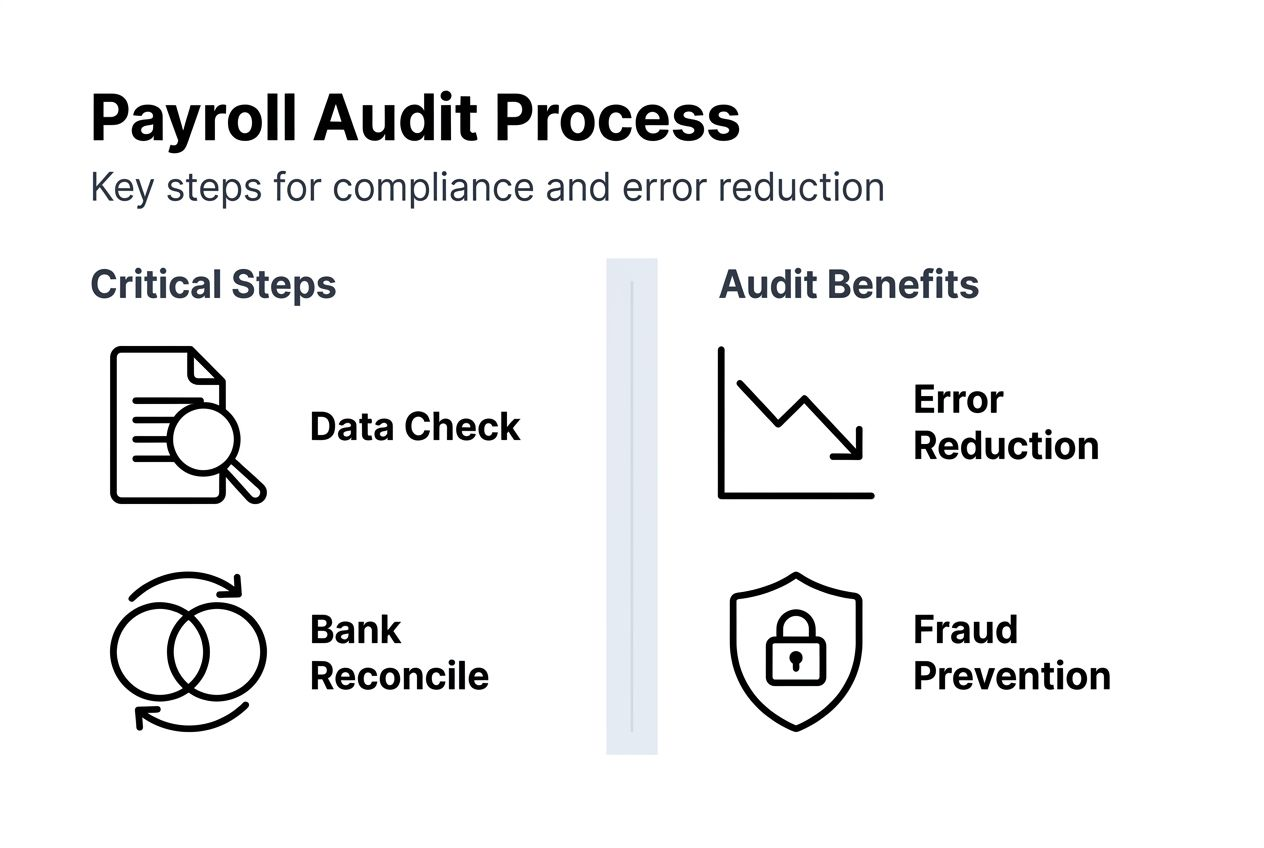
Step 1: Gather and verify employee data and contracts. Obtain current payroll registers listing all employees and their pay details. Cross-reference this list against HR records including employment contracts, job descriptions, and authorised salary levels. Verify that each payroll entry corresponds to a legitimate employee with proper documentation. Check that pay rates match contracted amounts and that any changes have appropriate approval trails.
Step 2: Reconcile payroll registers with accounting and bank records. Compare total payroll costs in your payroll system against general ledger postings and actual bank payments. This three-way reconciliation identifies discrepancies indicating errors or irregularities. Investigate any differences exceeding minor rounding amounts. Verify that tax and National Insurance deductions in payroll records match amounts remitted to HMRC.
Step 3: Review statutory deductions including income tax, National Insurance, and pensions. Confirm tax codes match HMRC notices and apply correctly to employee circumstances. Verify National Insurance categories align with employee status and age. Check pension contributions meet auto-enrolment requirements for qualifying workers. Ensure all statutory payments like sick pay and maternity pay follow current rates and eligibility rules.
Step 4: Check benefits and expenses calculations against policies and laws. Review company car benefits, private medical insurance, and other taxable benefits for correct valuation and tax treatment. Verify expense reimbursements comply with HMRC guidelines and company policies. Confirm benefit-in-kind reporting occurs properly through P11D processes and payrolling where applicable.
Step 5: Analyse payroll changes for irregular or unauthorised adjustments. Examine salary changes, bonus payments, and termination settlements for proper authorisation and documentation. Review new starters and leavers to confirm accurate processing timing. Look for patterns suggesting potential manipulation including consistent overtime claims, unusual benefit allocations, or payment anomalies.
Step 6: Document findings, categorise by risk and impact, and recommend corrective actions. Create a comprehensive report listing all errors, compliance gaps, and control weaknesses identified. Use the risk framework described earlier to prioritise issues requiring immediate attention. Provide specific recommendations for addressing each finding including process changes, system configurations, and training needs.
Common pitfalls to avoid during payroll audits include:
- Ignoring minor discrepancies that might indicate systematic problems
- Relying solely on system reports without manual verification
- Failing to document reasoning behind conclusions
- Overlooking off-cycle payments like bonuses and corrections
- Neglecting to verify the audit trail for sensitive changes
Pro Tip: Create standardised checklists for each audit step covering all verification points and documentation requirements. This ensures consistency across audit cycles and helps less-experienced staff conduct effective reviews without overlooking critical elements.
Real-world examples of payroll audit benefits
Actual UK business experiences demonstrate the substantial value payroll audits deliver through error reduction, financial recovery, and compliance improvements. These examples illustrate how systematic reviews protect businesses of various sizes and sectors.
A UK manufacturing firm with 150 employees implemented quarterly payroll audits after experiencing recurring HMRC enquiries. The first audit uncovered 23 employees with incorrect tax codes and 8 instances of miscalculated overtime payments. Over 12 months, error rates dropped by 40% as the business corrected system configurations and strengthened approval processes. The compliance improvements eliminated HMRC penalties that had averaged £2,400 annually.
A professional services company discovered £25,000 in recoverable amounts during its inaugural payroll audit. The review identified 12 former employees continuing to receive benefit allowances after termination, totaling £18,000 over 18 months. Additional findings included £7,000 in duplicate expense reimbursements processed during a system migration. The audit paid for itself many times over whilst highlighting control weaknesses requiring immediate attention.
A retail business with multiple locations strengthened payroll processing controls following audit recommendations. The business implemented dual approval requirements for all salary changes and automated exception reporting for unusual payment patterns. These enhancements reduced unauthorised adjustments by 85% whilst improving processing speed through better-defined procedures. Employee complaints about pay errors decreased significantly, improving HR efficiency and workplace satisfaction.
Key benefits realised across these UK payroll audit case studies include:
- Measurable cost savings exceeding audit investment through error prevention and recovery
- Enhanced HMRC compliance reducing penalty exposure and enquiry frequency
- Stronger internal controls deterring fraud and catching mistakes earlier
- Improved employee trust through consistent, accurate payment processing
- Better management visibility into payroll risks and control effectiveness
These examples demonstrate that payroll audit value extends beyond immediate error detection. Businesses achieve lasting improvements in processes, controls, and compliance culture. The systematic approach encourages continuous improvement rather than reactive problem-solving. For additional insights into payroll audit benefits UK firms experience, explore comprehensive guides on strengthening financial controls.
The payroll audit financial benefits compound over time as businesses maintain audit discipline. Regular reviews prevent error accumulation, maintain compliance standards, and reinforce control environments. These ongoing advantages justify the modest investment required for systematic payroll verification.
Discover tailored payroll audit support with LS25 Accountants
Implementing effective payroll audits requires expertise in UK tax regulations, accounting principles, and risk assessment frameworks. LS25 Accountants provide expert payroll audit services tailored to your business size and industry requirements, helping you minimise financial risks whilst ensuring full compliance with HMRC obligations.

Our experienced team conducts comprehensive payroll reviews identifying errors, compliance gaps, and control weaknesses before they create costly problems. We help you develop practical audit procedures scaled to your resources, implement corrective actions addressing root causes, and maintain ongoing compliance through regular verification. Whether you need one-off audit support or systematic review frameworks, we deliver solutions protecting your business and employees.
Contact LS25 Accountants today to explore custom payroll audit solutions suited to your circumstances. We also provide extensive accountancy guides LS25 businesses rely on for expert insights into tax planning, financial management, and regulatory compliance across all aspects of your operations.
Frequently asked questions
Why is it important to conduct payroll audits regularly?
Regular payroll audits catch errors quickly, ensuring statutory compliance with PAYE, National Insurance, and pension requirements whilst preventing fraud before problems escalate. They protect your business from costly HMRC penalties and improve employee trust through consistent, accurate payments that demonstrate professional administration.
What are the key signs that indicate a payroll audit is needed?
Frequent payroll discrepancies, employee complaints about incorrect pay, or sudden unexplained increases in payroll costs signal audit needs. Changes in tax legislation, system upgrades, staff turnover in payroll roles, or upcoming HMRC enquiries also warrant thorough reviews of your processes and records.
How can small businesses effectively conduct payroll audits without extensive resources?
Small businesses can adopt scaled manual audits combined with software exception reports to ensure accuracy affordably, focusing reviews on high-risk areas like new starters, leavers, and statutory calculations. Maintain clear documentation of verification steps and findings, conducting focused quarterly reviews rather than exhaustive annual examinations to spread workload whilst catching problems promptly.
What are the consequences of ignoring payroll audits in UK businesses?
Ignoring audits allows undetected errors to accumulate, leading to compliance breaches, substantial HMRC penalties starting at £100 monthly, and damage to employee relations through persistent pay problems. Long-term financial risks increase significantly through uncorrected overpayments, fraud losses averaging 5-7% of payroll budgets, and regulatory scrutiny that consumes management time whilst harming business reputation.